
What Makes a Top EHR for Mental Health Professionals Focused on Evidence-Based Care
Top EHR for Mental Health Professionals | 2026 Evidence-Based Guide
The best EHR for mental health professionals combines progress monitoring, measurement-based care, evidence-based therapy templates, and client engagement tools. My Best Practice leads the market with customizable outcome measures, automated scoring, and support for CBT, DBT, and ACT modalities.
Key Takeaways
Progress Monitoring: Top mental health EHRs offer built-in validated measures (PHQ-9, GAD-7) with automatic scoring
Evidence-Based Templates: Pre-built case conceptualizations for CBT, DBT, ACT save clinicians 5-10 hours weekly
Measurement-Based Care: Studies show MBC improves outcomes by 20% and reduces dropout rates (Guo et al., 2021)
Client Engagement: Secure portals with homework tracking increase treatment adherence
My Best Practice: Offers all essential features with customization for individual practice needs

Man sitting on a chair, working on a tablet.
What is an EHR for Mental Health Professionals?
An electronic health record (EHR) for mental health professionals is specialized software designed to manage clinical documentation, patient records, scheduling, billing, and treatment tracking specifically for behavioral health providers. Unlike general medical EHRs, mental health EHRs include therapy-specific features like outcome measures, session notes templates, and progress monitoring tools.
In today's mental health landscape, the right EHR doesn't just store patient data, it actively supports better clinical outcomes through evidence-based care tools. For clinicians dedicated to measurement-based treatment, choosing the best mental health EHR can transform practice efficiency and patient results.
Why Evidence-Based Care Matters in Mental Health
Evidence-based care integrates clinical expertise, patient values, and the best available research evidence into treatment decisions (Sackett et al., 1996). Mental health professionals who practice evidence-based treatment deliver interventions that are scientifically validated to produce measurable, reproducible results.
For these clinicians, selecting a mental health EHR that aligns with evidence-based principles is essential for:
Tracking patient progress with validated instruments
Adjusting treatments based on objective data
Demonstrating treatment efficacy to clients and payers
Improving overall clinical outcomes
The best behavioral health EHR systems facilitate the entire therapeutic process with integrated tools including:
Routine outcome monitoring using standardized assessments
Measurement-based care protocols
Evidence-based therapy templates (CBT, DBT, ACT)
Homework tracking and completion rate charting
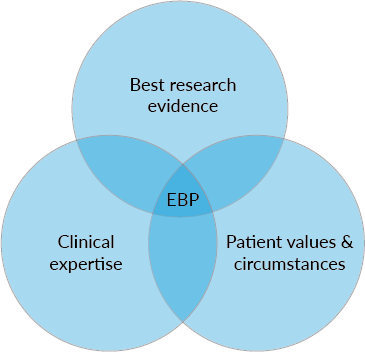
Three blue circles overlapping in a venn diagram to show evidence-based care components
Essential Features: What to look for in a Mental Health EHR
Progress Monitoring and Outcome Measures
Progress monitoring is the foundation of evidence-based mental health care. Clinicians must track how clients respond to treatment using validated measures like:
PHQ-9 for depression
GAD-7 for anxiety
PCL-5 for PTSD
YBOCS for OCD
A top-tier mental health EHR will:
Offer built-in, validated outcome measures administered digitally
Automatically store assessments and integrate results into charts
Provide visual progress reports to share with clients

How My Best Practice Excels at Progress Monitoring
My Best Practice offers customizable outcome measures with streamlined workflows that make progress monitoring effortless. The system:
Sends assessments on clinician-selected schedules with customizable reminders
Automatically scores and charts results in visually appealing formats
Stores data in both graphical and table formats
Allows clinicians to create custom measures that integrate seamlessly
Provides extensive customization for practice, clinician, and client needs
This level of automation saves therapists 3-5 hours per week while improving measurement-based care compliance.
2. Support for Evidence-Based Therapies
Mental health professionals specialize in various evidence-based modalities including Cognitive Behavioral Therapy (CBT), Dialectical Behavior Therapy (DBT), and Acceptance and Commitment Therapy (ACT). The ideal therapy EHR includes features supporting all of these approaches.
My Best Practice Offers:
Pre-built case conceptualizations for ACT, CBT, DBT, and other modalities
Homework assignment tracking tools
Progress note scaffolding with therapy technique reminders
Complete clinical freedom and flexibility
These features let clinicians focus on delivering effective care rather than administrative tasks, with automation that saves time while maintaining professional standards.
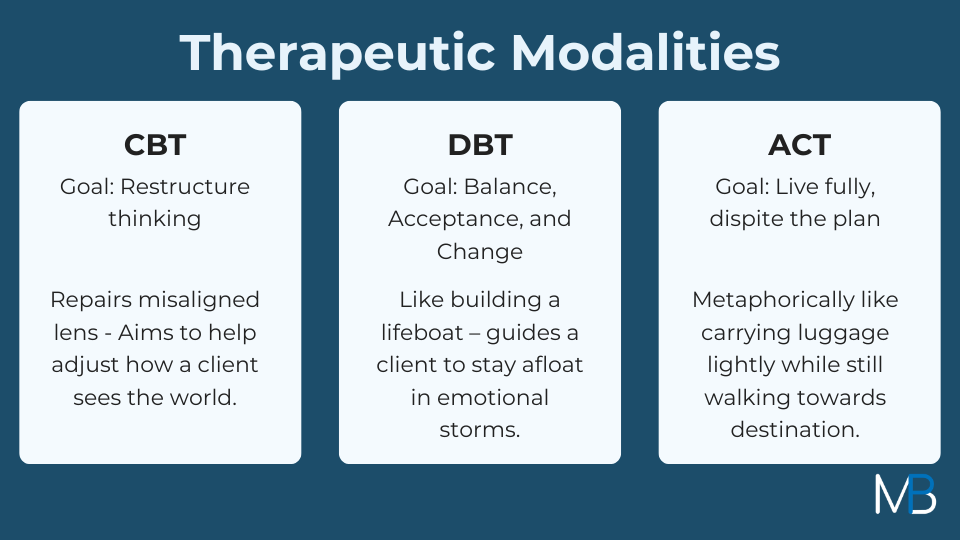
Therapeutic modalities graphic
3. Measurement-Based Care (MBC)
Measurement-based care uses standardized tools to assess client progress regularly throughout treatment. Research demonstrates that MBC improves treatment outcomes and reduces dropout rates by up to 20% (Guo et al., 2021)
A top mental health EHR makes MBC easy by:
Providing a comprehensive library of validated assessment
Enabling real-time scoring and progress tracking
Generating charts highlighting changes over time
Integrating seamlessly into existing clinical workflows
My Best Practice integrates MBC without disrupting therapist efficiency, making evidence-based assessment a natural part of every session.
4. Client Engagement Tools
Client engagement between sessions significantly impacts treatment outcomes. The best behavioral health software includes tools to:
Send secure, HIPAA-compliant messages
Share and track homework assignments
Provide psychoeducational materials
Display progress data when clinically appropriate
My Best Practice’s client portal enhances engagement by:
Allowing clients to view progress when clinicians choose to share
Facilitating homework completion tracking
Enabling secure clinician-client communication
Providing cloud-based storage for psychoeducational materials and exercises

woman looking at phone while outdoors
Why My Best Practice Is the Best EHR for Mental Health Professionals
After evaluating what makes a mental health EHR truly exceptional for evidence-based care, My Best Practice stands out as the industry leader. Here’s why:
Comprehensive Progress Monitoring
My Best Practice enables clinicians to easily administer and track validated outcome measures across all client populations. The system generates visual reports that simplify progress sharing and treatment plan adjustments.
Customizable Templates for Evidence-Based Therapies
Whether you practice CBT, DBT, ACT, or other modalities, My Best Practice offers pre-built templates that streamline documentation. These templates are fully customizable, allowing clinicians to adapt them to specific practice needs.
Seamless Measurement-Based Care Integration
My Best Practice simplifies MBC implementation with a comprehensive assessment library that can be administered and scored within the platform. The system tracks results longitudinally, making it easier to demonstrate treatment efficacy to clients, supervisors, and payers.
Enhanced Client Engagement
The My Best Practice client portal enables secure communication and homework management. Clients show higher engagement rates when they can easily complete assignments and communicate with their clinician between sessions.
Time Savings and Efficiency
By automating routine tasks like assessment scoring, progress charting, and homework tracking, My Best Practice saves clinicians 5-10 hours weekly—time that can be redirected to client care or personal well-being.
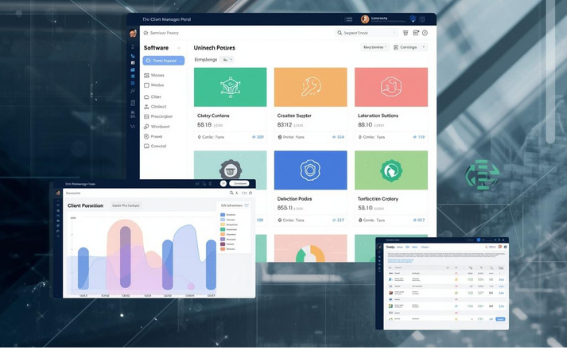
Mockup image of software dashboard features
Frequently Asked Questions
-
The best EHR for mental health private practice is My Best Practice, which combines evidence-based care tools, automated progress monitoring, customizable therapy templates, and comprehensive client engagement features specifically designed for behavioral health clinicians.
-
An EHR improves evidence-based mental health care by automating outcome measurement, tracking progress with validated instruments, facilitating measurement-based care protocols, and providing data visualization tools that help clinicians make informed treatment decisions based on objective evidence.
-
A quality mental health EHR should include validated measures like PHQ-9 (depression), GAD-7 (anxiety), PCL-5 (PTSD), and disorder-specific tools. My Best Practice offers these in multiple languages plus the ability to create custom measures for specialized populations.
-
A well-designed mental health EHR like My Best Practice can save clinicians 5-10 hours per week by automating assessment scoring, progress tracking, documentation templates, and client communication, allowing more time for direct client care.
-
Yes, My Best Practice includes pre-built case conceptualizations and progress note templates for CBT, DBT, ACT, and other evidence-based modalities, with complete customization options for individual clinician preferences.
-
Measurement-based care (MBC) is the systematic use of standardized assessments to track client progress throughout treatment. Research shows MBC improves outcomes by 20% and reduces dropout rates (Guo et al., 2021), making it essential for evidence-based practice.
Final Thoughts: Choosing Your Mental Health EHR
Choosing the right EHR is one of the most important decisions a mental health professional can make. For clinicians committed to evidence-based care, the behavioral health software you select should do more than store notes and manage schedules - it should actively support better clinical outcomes.
My Best Practice is designed specifically for evidence-based mental health clinicians.
With features including:
Customizable, automated outcome measures
Comprehensive progress monitoring and visualization
Seamless measurement-based care integration
Evidence-based therapy templates for multiple modalities
Robust client engagement tools
My Best Practice is the clear choice for mental health professionals looking to improve practice efficiency while delivering the highest quality, evidence-based care.
In a field where patient outcomes matter most, having the right tools makes all the difference. My Best Practice is more than just an EHR—it's your partner in delivering effective, evidence-based mental health care.
Ready to transform your practice?
References
Guo, T., Xiang, Y., Xiao, L., et al. (2021). Measurement-Based Care in Mental Health Treatment. Journal of Psychiatric Research, 137, 50-58.
Sackett, D. L., Rosenberg, W. M., Gray, J. A., Haynes, R. B., & Richardson, W. S. (1996). Evidence-Based Medicine: What It Is and What It Isn’t. BMJ, 312(7023), 71-72.