
How Do I Start a Private Practice: A Step-by-Step Guide for Mental Health Professionals

A mental health professional’s private practice office set up.
Starting a private practice is one of the most significant professional decisions a clinician can make. This guide walks through the core questions every therapist, psychologist, or counselor should answer before launching, so the foundation is built on clarity rather than guesswork.
Why Do You Want to Start a Private Practice?
Before anything else, get clear on your values. In Acceptance and Commitment Therapy (ACT) and related frameworks, this is called values clarification. Values are not goals. They are not completed; they guide ongoing direction.
Ask yourself: What matters most about having a private practice?
Common values clinicians identify include:
Autonomy and flexibility
Helping and compassion
Financial security
Learning and professional growth
Collaboration and connection
Identify your top three values. They will anchor every decision that follows.

Compass demonstrating values-based decision making.
What Type of Practice Do You Want?
Practice structure options:
Solo private practice
Group practice within your profession
Interdisciplinary group practice
Services to consider offering:
Individual, couples, or family therapy
Psychological or educational assessments
Forensic or pre-surgical evaluations
Coaching or consultation (clinical, educational, organizational)
How you spend your time matters too. Map each service and role to your values. For example:
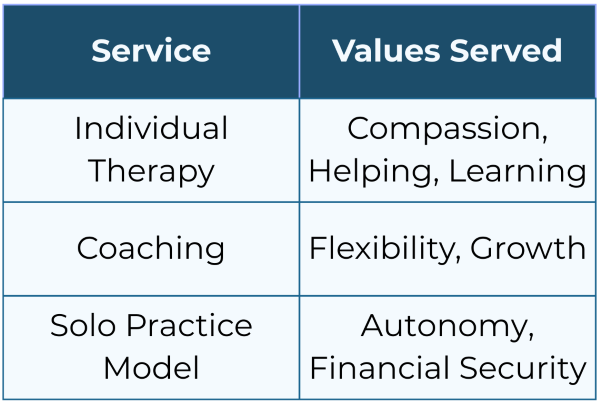
Services and Values table example to examine private practice priorities
This exercise clarifies not just what you want to do, but what legal structure, staffing, and software you will need.
How Do You Define And Measure Success?
Success is only meaningful if it is defined in advance. If financial security is a core value, set a specific revenue target with a deadline. Then evaluate it objectively.
When reviewing progress:
Assess whether goals were realistic
Identify specific obstacles (pricing, marketing vendor performance, referral gaps)
Revise the plan and set a new timeline
Repeat
Avoid self-criticism as a strategy. A post-mortem analysis works better than self-blame.
How Do You Get Therapy Clients?
This is the central challenge of private practice. There is no shortcut, despite what many courses and consultants claim.
If you plan to accept insurance:
Apply to insurance panels immediately. Competitive markets can take months or longer for approval.
In-network status provides a more predictable referral flow and lower client financial barriers.
For private pay clients, the most effective long-term strategies are:
Clinical excellence. Word-of-mouth is the most trusted referral source and compounds over time.
Develop a niche. Specialization builds credibility with both referral sources and potential clients. It also supports media visibility and speaking opportunities.
Build a strong website. It should clearly communicate your approach, credentials, services, and what clients can expect.
Network intentionally. Connect with physicians, physical therapists, faith leaders, personal trainers, and other professionals who serve your target population.
Join professional organizations. State psychological associations, Rotary groups, and business networks create referral relationships.
Track your customer acquisition cost (total marketing spend divided by new clients) to evaluate what is working.

Therapist building referral network for private practice.
What EHR Is Best For Your Practice?
The right Electronic Health Record (EHR) depends on your practice structure and priorities. Before comparing options, clarify:
Who will use it? Just you, partners, billing staff, non-clinical team members?
What features are essential vs. nice-to-have? (HIPAA messaging, appointment reminders, integrated billing, clinical tools)
What is your budget? Pricing models vary widely. Some charge per feature; others offer flat subscriptions.
An EHR with integrated billing eliminates duplicate data entry and gives you real-time financial reporting, which is especially valuable for solo practitioners without a dedicated bookkeeper.
Practical Set Up: What You Need Before Opening
Legal and financial:
Consult an accountant and/or tax attorney to choose the right business structure (PLLC, S-Corp, Partnership)
Open a dedicated business checking account early
Obtain a business credit card (many clinicians use a bank debit card plus a business Amex for benefits)
Location considerations:
Subletting from an established practitioner is low-risk and may generate referrals
Traditional leases offer stability but limit flexibility; month-to-month costs more but provides agility
Home offices require careful consideration of boundaries and patient population risk
Co-working healthcare spaces are a growing option: lower cost, built-in community, flexible scaling
Insurance you will likely need:
Malpractice/professional liability (required)
General liability (often required by landlords)
Health insurance if not covered elsewhere
Disability insurance (worth discussing with a financial advisor)
Technology:
At minimum, you need a system for bookkeeping: spreadsheet software, dedicated software like QuickBooks or Xero, or an integrated EHR
The most efficient approach is an EHR that handles both clinical records and financial tracking.
What Else Should You Know Before Starting?
Private practice offers significant clinical and financial upside, but the risks are real.
Expect:
Revenue volatility, especially early on and around holidays and seasonal shifts
Slower growth than consultants often promise
Professional isolation if you are coming from a team-based setting
The emotional weight of intensive clinical work without built-in peer support
Protect yourself by:
Building regular peer consultation into your schedule
Planning for 10-20% revenue fluctuation (even a full caseload can drop quickly with two terminations)
Prioritizing self-care as a business strategy, not just a personal one
Using data (your EHR reports) to evaluate your business objectively, not emotionally
Private practice is not the right fit for everyone, and that is a legitimate outcome. If it stops serving your values, adjusting course is not failure. It is good clinical judgment applied to your own career.
Frequently Asked Questions:
-
Most clinicians should plan for 12 to 24 months to build a stable, full caseload, particularly in private pay models. In-network practices typically fill faster due to insurance referral pipelines.
-
Not on day one, but implementing one early prevents expensive data migration later. Look for a platform that handles both clinical documentation and billing.
-
Office rent is typically the largest single cost. Choosing the right location and lease structure has a direct impact on profitability, especially in early stages.
This guide is intended for licensed mental health professionals considering independent practice. Consult a licensed attorney and accountant before making legal and financial decisions.