
In January 2026, Matthew Church, the mental health technology editor at ChoosingTherapy, created a set of test clients inside My Best Practice to see how the system performs day-to-day. He rated the product as "Best For: Solo and small practices that want an affordable EHR".
He also found that for larger practices, it easily supports multiple locations, practitioners, non-clinical staff, and even staff groups. In this post, we’ll explore how My Best Practice can support fifteen clinicians and more than one office.
The product exists because of a second office. Years before My Best Practice, Ryan Fuller built an EHR for his own group practice, New York Behavioral Health, and it ran until it had to run in two places. Networking it between the Manhattan and Long Island offices raised encryption and HIPAA problems. Later, a conversation with the person who became his co-founder started My Best Practice, and managing different offices was on the list from the start.
Which EHR lets supervisors manage multiple providers and locations?
An EHR becomes a group practice EHR at the second office. Adding a clinician is a login; adding an office is a network. A two-partner firm sharing one suite is still a partnership, and the day it signs a second lease it becomes an organization, with three decisions arriving alongside the keys: which files travel between the offices, who holds the key to which cabinet, and how the monthly revenue is split.
My Best Practice supports multiple locations, practitioners, non-clinical staff, and staff groups.
Ryan describes this as three domains that need to be integrated in one place:
- The clinical work
- The research side (data collection and analysis)
- The business side (a calendar that can handle multiple providers and locations, billing, credit card processing, payroll, revenue, and many other reports).
This is what My Best Practice does. An owner can run several offices and all of their clinicians from one account, sort staff into groups, and set each person's level of access. A supervisor can efficiently review and sign notes, and clinicians and administrators have streamlined workflows that save time and decrease stress, while improving clinical care and clients’ overall experience with the practice.
One calendar for two offices
The schedule comes first. A scheduler can keep every clinician's client and personal appointments on one calendar, view several therapists at once, and sync it with the Google Calendars people already live in. Each clinician can set her own availability rules, which keeps bookings from colliding, and Church called the scheduling tools dependable and flexible enough to rely on full-time.
Who can see which record
An owner can set a different access level for each staff member, which is how a practice keeps the right people on the right records. Practice-wide files and each clinician's own documents sit in separate areas. An access level is the key to the cabinet, which is authorization. The lock on the truck between the offices is a different thing, and the records, messages, documentation, and billing data now sit in a HIPAA-compliant system.
What the payroll report replaced
When asked on Private Practice Elevation to name his favorite features, Ryan picked the automated superbills and the payroll report, and called the choice embarrassing. He used to spend part of every month in Excel working out who was owed what, by percentage, by salary, or by what each clinician had collected. Now the client gets superbills and receipts without the therapist or the owner doing anything, and the owner can open the payroll report and read what each person is to be paid this month.
What an EHR costs for fifteen clinicians
Our pricing page lists clinicians at $39 a month for the first and $19 for each additional one, telehealth at $20 a month per clinician, E-Scripts at $99 a month per clinician, and schedulers, billers, and bookkeepers as unlimited; the features page adds that they carry no per-seat fee. ChoosingTherapy listed "Lower total cost than many competitors" among the pros.
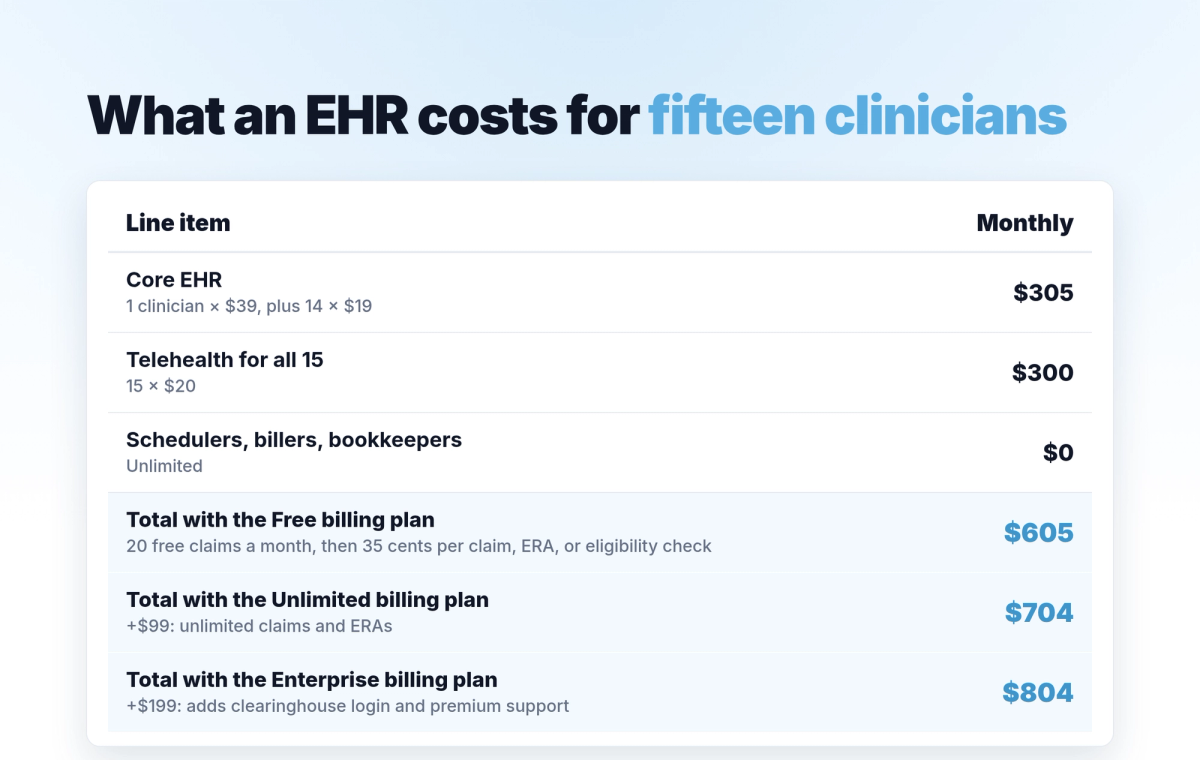
A private-pay group of fifteen that files few claims pays about $605 a month with telehealth for every clinician. A group of fifteen billing insurance is likely to pass twenty claims early in the month, and then either pays 35 cents for each additional claim, ERA, or eligibility check, or moves to the $99 total for unlimited claims and ERAs for the entire group; e.g., a practice could file 2,000 claims per month, and the maximum the entire practice would pay for claims for the month is always $99.
A practice moving from another system can take the Standard Migration, which comes with a planning checklist, export guidance, help organizing the data, and launch preparation, or the White Glove Migration, a one-time $499 per group, which assigns the practice a dedicated migration specialist who meets with leadership, configures settings, creates forms, transfers files, and trains the staff. The trial is 14 days, and everything is monthly, with no long-term contracts.
Where ChoosingTherapy marked it down
Church scored Reporting and Administrative Tools 3 out of 5: while "reporting options aren't as deep or customizable as those found in larger enterprise platforms, they cover the essentials most therapy practices need". His cons list includes "Mobile apps are limited" and does not say which functions. Our features page lists the app as covering the schedule, client communication, reports, and payments on iOS and Android, so a practice that needs notes written on a phone can check that in the trial. It’s important to note that our reporting has become much more robust since then, and the client and clinician apps are very easy to use and have full functionality.
Best EHR for a practice with 10 to 20 clinicians
For a practice of this size, the biggest line in the comparison is the clinician:
- $19 a month for each one after the first on My Best Practice (plus $20 for telehealth).
- $72 for each added clinician on SimplePractice Plus.
You can see the full comparison of the two platforms here, which has the full rate card. Adding any team member on SimplePractice requires the Plus plan, each added clinician costs $72 a month in a practice with 6 to 15 clinicians, and "billers, schedulers, and supervisors are free". SimplePractice also offers group appointments for up to 15 clients.
For ten clinicians, you’re looking at roughly $747 a month on SimplePractice Plus against about $410 on My Best Practice with telehealth for everyone.
That difference, $33 a month on every clinician after the first, grows with the practice. The sections above cover the rest of what a group of this size needs, from one calendar across every office and an access level for each person on staff to a payroll report at the end of the month instead of a spreadsheet. When the sixteenth clinician joins, adding her costs $19 a month (plus $20 if she needs telehealth).
Start the 14-day free trial with your own clinician list.