
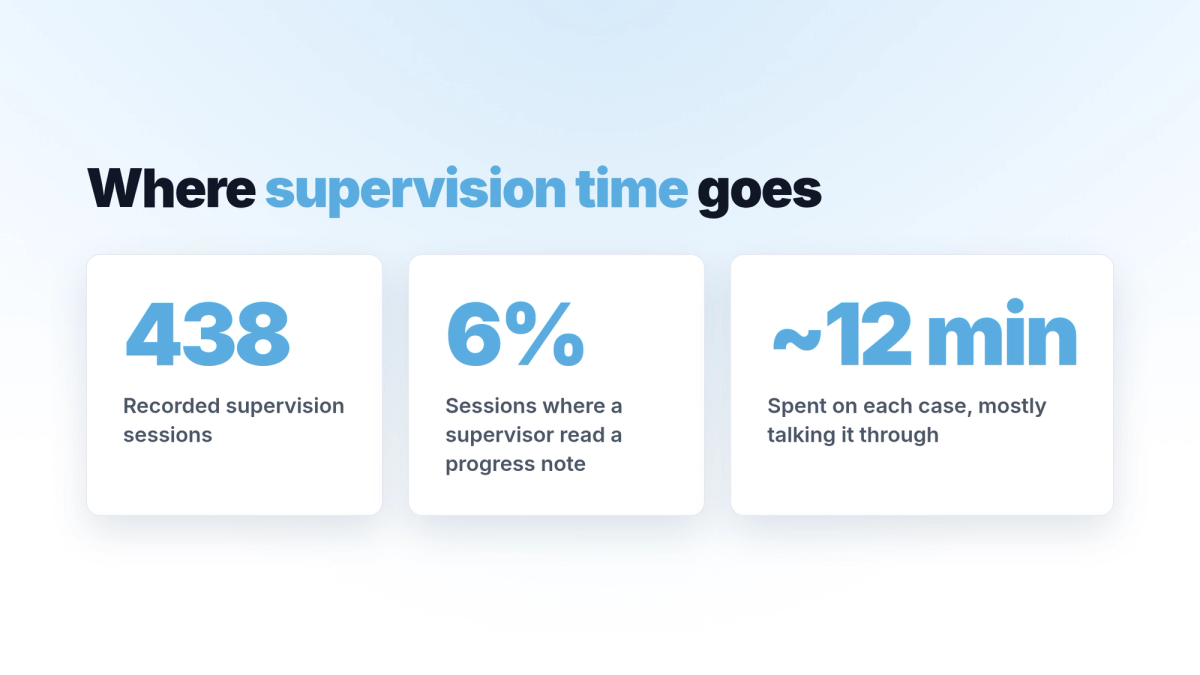
Supervisors read a progress note in 6% of supervision sessions, in a study of 438 recorded sessions in Washington State. The 28 supervisors and 70 clinicians had about 12 minutes per case, and they spent it talking through the case, not reading the chart. So if a group practice wants its supervisors to see the notes, the weekly meeting is rarely where that happens.
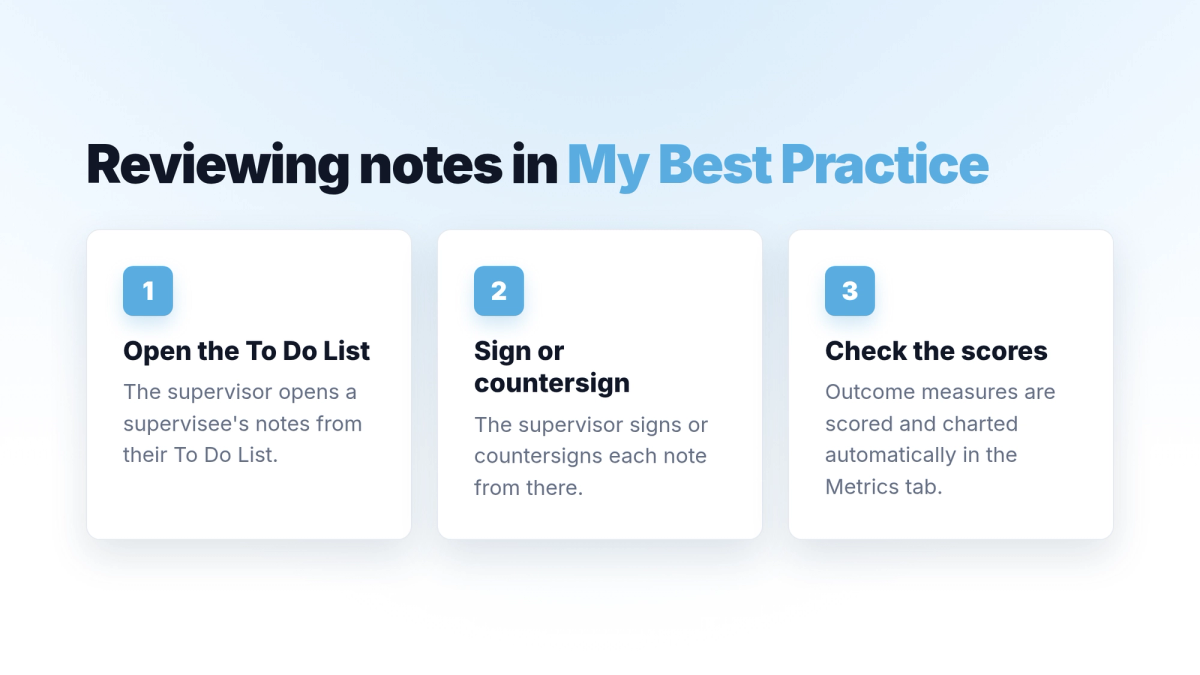
On My Best Practice, a supervisor can easily open a supervisee's notes and sign or countersign them using their To Do List. This supervisory feature streamlines the whole process and saves supervisors time.
How do supervisors review and sign clinicians' notes in a group practice EHR?
A supervisor can review a supervisee's notes and sign or countersign them. An owner can limit each clinician to their own clients' records.
A supervisee can write a custom note from any theoretical perspective, e.g., CBT, DBT, ACT, or REBT, or from templates that are available to every provider. A clinician who runs a couple, family, or group session can document it once and sync the note to each member's individual chart.
Clinical supervision has a small, unconfirmed effect on client outcomes
Supervision seems to make therapists better at the work; whether it makes clients better is still open. A meta-analysis of 32 studies covering 2,282 clients found a large effect of supervision on therapist competence and a small effect on client symptoms that did not reach statistical significance. The authors rated the evidence very low in certainty and called both effects tentative.
It made no measurable difference which supervisor a trainee had. In six years of records from a university counseling center, 3,030 clients saw 80 trainee therapists under 39 supervisors, and the supervisor accounted for none of the difference in how clients did. Every client filled out an outcome questionnaire (the OQ-45.2) before every session, and the supervisor could have read the scores, but no one recorded whether any supervisor did. The center had no unsupervised trainees, so the authors could not say whether supervision itself mattered.
Few clinicians bring outcome scores into supervision at all. A scoping review of 17 studies found that in one United States study of 318 clinicians, about one in five (19.3%) had done so, and a quarter (26.5%) of 238 training-clinic directors said their clinics collected and discussed the scores in supervision. The one randomized trial the authors found showed no significant difference in client outcomes when the scores were shared with the supervisor. Clinicians named two barriers: the time it takes to collect and read the data, and too little training in reading it. The review's authors called the evidence fragmented. On My Best Practice, a clinician can schedule the PHQ-9 or GAD-7 for a client in English, Spanish, or Chinese. The client completes it before the session, the system automatically scores and charts it, and the clinician and the supervisor can select the Metrics tab and see the charted scores or a table.
How many supervision hours do state boards require?
New York's Office of the Professions lists, for psychologist license applicants, two years of full-time supervised experience defined as 1,750 clock hours a year, under a psychologist licensed where the experience occurs. For full-time experience, it lists weekly supervision with at least one hour a week of individual face-to-face supervision and one additional hour that can be face-to-face or group supervision, seminars or workshops, or apprenticeship activities. California's Board of Behavioral Sciences lists 3,000 total supervised hours over a minimum of 104 weeks for LMFT applicants.
What a group practice pays each month
The core EHR costs $39 a month for the first professional and $19 a month for each additional one. Telehealth is $20 a month per professional, and an owner can add schedulers, billers, and bookkeepers without a per-seat fee.
| Clinicians | Core EHR | Core EHR with telehealth for every clinician |
|---|---|---|
| 5 | $115 | $215 |
| 10 | $210 | $410 |
| 15 | $305 | $605 |
| 20 | $400 | $800 |
Monthly subscription at list price for each practice size, before claim fees and add-ons.
The Free billing plan covers 20 claims a month and then charges 35 cents for each additional claim, ERA, or eligibility check; the Unlimited plan is $99 a month for unlimited claims and ERAs; the Enterprise plan is $199 a month and adds a clearinghouse login and premium support.
A group of fifteen clinicians, each with telehealth, pays $605 a month for the subscription, or $704 on the $99 Unlimited billing plan. When the sixteenth clinician starts, the owner can add them for $19 a month, or $39 with telehealth, and set their access level and staff group, and any supervisor they report to can read and sign their first note.
Start a 14-day free trial; there is no long-term contract, and a practice can cancel at any time.
Disclaimer: This post is for general information only. It does not provide legal, ethical, or clinical guidance, and it is not a substitute for advice from an attorney, your licensing board, your professional association, or a qualified clinical supervisor or consultant. The studies described here were done in specific settings, and their findings may not apply to your practice. Before making decisions about your staff, your compliance obligations, or client care, consult the appropriate professionals.
References
- American Psychological Association. (2025). Guidelines for clinical supervision in health service psychology. https://www.apa.org/about/policy/guidelines-supervision.pdf
- California Board of Behavioral Sciences. (n.d.). LMFT applicants. https://www.bbs.ca.gov/applicants/lmft.html
- Dorsey, S., Kerns, S. E. U., Lucid, L., Pullmann, M. D., Harrison, J. P., Berliner, L., Thompson, K., & Deblinger, E. (2018). Objective coding of content and techniques in workplace-based supervision of an EBT in public mental health. Implementation Science, 13, 19. https://doi.org/10.1186/s13012-017-0708-3
- Fuller, J. R. (n.d.). How to run routine outcome monitoring in a group practice. My Best Practice. https://www.mbpractice.com/blog/routine-progress-monitoring-in-therapy/
- Fuller, J. R. (2026, September 11). Group therapy practice management software with AI progress notes: A 2026 guide. My Best Practice. https://www.mbpractice.com/blog/group-therapy-practice-management-software-ai-progress-notes/
- My Best Practice. (n.d.). Features. https://www.mbpractice.com/features
- My Best Practice. (n.d.). Frequently asked questions. https://www.mbpractice.com/faqs-frequently-asked-questions/
- My Best Practice. (n.d.). My Best Practice [Home page]. https://www.mbpractice.com/
- My Best Practice. (n.d.). Pricing and insurance. https://www.mbpractice.com/pricing-and-insurance/
- New York State Education Department, Office of the Professions. (n.d.). Psychology: License requirements. https://www.op.nysed.gov/professions/psychology/license-requirements
- Schreyer, B., Leithner, C., Eilers, R., Gossmann, K., & Rosner, R. (2025). The effects of clinical supervision on supervisees and patient outcomes in psychotherapy: A systematic review and meta-analysis. Frontiers in Psychiatry, 16, 1705578. https://doi.org/10.3389/fpsyt.2025.1705578
- Teti, A., Lo Coco, G., Gelo, O. C. G., Lagetto, G., Tasca, G., & Gullo, S. (2026). The use of routine outcome monitoring in clinical supervision: A scoping review of empirical evidence. Clinical Psychology & Psychotherapy, 33(5), e70314. https://doi.org/10.1002/cpp.70314
- Whipple, J., Hoyt, T., Rousmaniere, T., Swift, J., Pedersen, T., & Worthen, V. (2020). Supervisor variance in psychotherapy outcome in routine practice: A replication. SAGE Open, 10(1). https://doi.org/10.1177/2158244019899047