
When one member of a therapy group asks for a copy of her record, the practice has to release her information without releasing anyone else's. The American Psychological Association's 2007 record keeping guidelines point out that a record covering several clients can compromise one client's confidentiality when another client's information is released, and they say a separate record for each member of a group may make sense.
How do you document a group therapy session for each client?
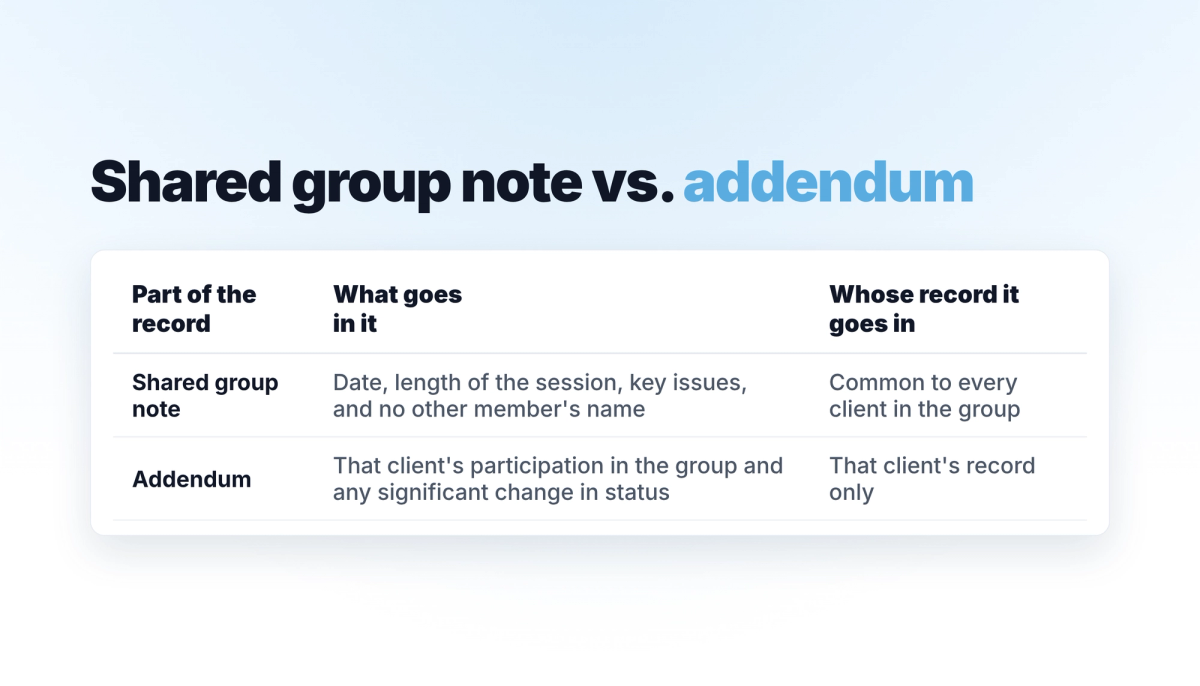
A clinician can write one shared note for the session that names no other group member, then add an addendum to each client's record on that client's participation and any significant change in status. That is the format set out by Novitas Solutions, the Medicare contractor for 11 states and the District of Columbia, in its local coverage determination (LCD) for psychiatric codes, the written policy it applies to Medicare claims in its region.
The same Novitas policy accepts a second format: a group note written to the guidelines Novitas sets for individual therapy notes, the elements described in what belongs in a mental health progress note.
In either format, Novitas expects each client's record to show the type of service, such as group or family, the content of the session, the therapeutic techniques used, and who performed the service. First Coast Service Options, the Medicare contractor for Florida, Puerto Rico, and the U.S. Virgin Islands, asks that the record for group and family psychotherapy show, on a periodic basis, the client's capacity to take part in therapy and benefit from it.
Documentation rules vary by Medicare contractor and by payer, so a practice outside the Novitas and First Coast regions may want to read its own Medicare contractor's LCD, and a practice billing commercial insurers or Medicaid plans may want to check each payer's own documentation policy.
Can other group members' names appear in a client's chart?
Novitas's policy describes a shared group note that names no other group member.
A client can ask for a copy of her record under HIPAA's right of access. If the record names another group member, the practice can deny access when a licensed health care professional judges that access is reasonably likely to cause that other person substantial harm, and the client can ask for the denial to be reviewed.
Under the APA's 2007 record keeping guidelines, a psychologist who receives a later request for records releases only the portions relevant to the person covered by the release.
Which CPT codes cover group and family therapy?
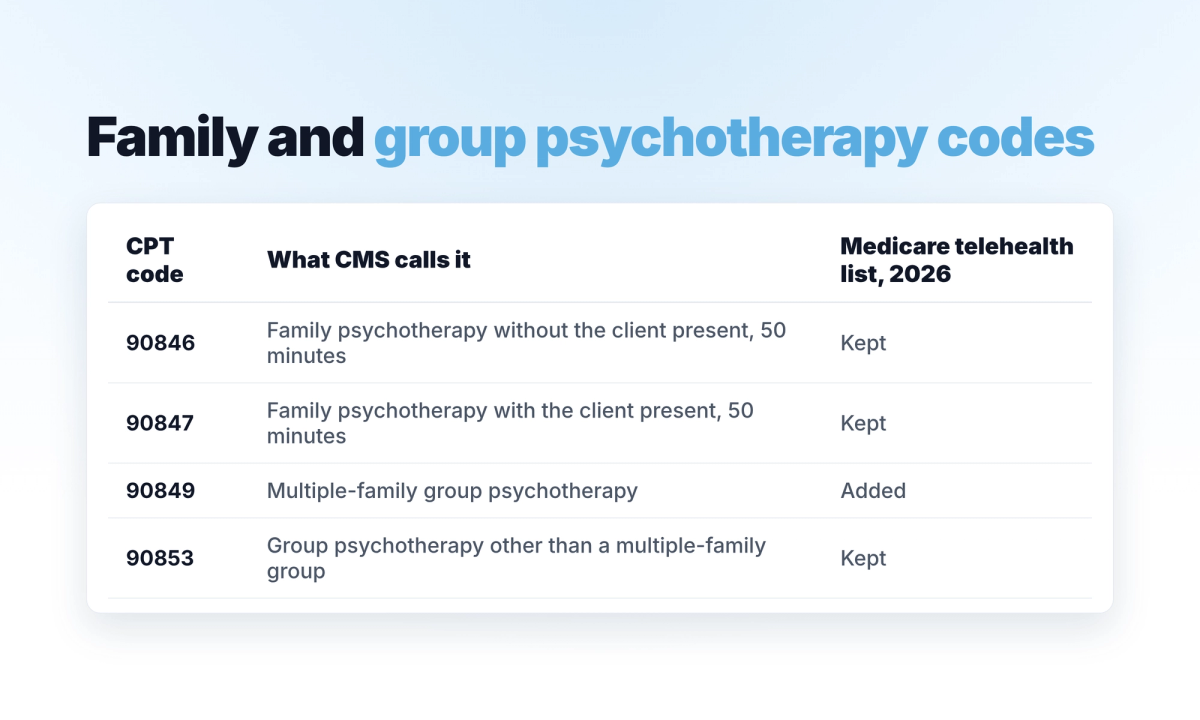
CMS lists four codes for group and family psychotherapy in its March 2026 booklet on Medicare mental health coverage. Three were already on Medicare's telehealth list, and CMS added the fourth, 90849, for 2026.
For a family session with or without the client, First Coast asks that the record show the medical necessity of that session, the themes addressed, how much the client took part and interacted with the family and the clinician, how the client and the family reacted to each other, and any change in the client's symptoms or behavior.
How many clients can be in a Medicare group therapy session?
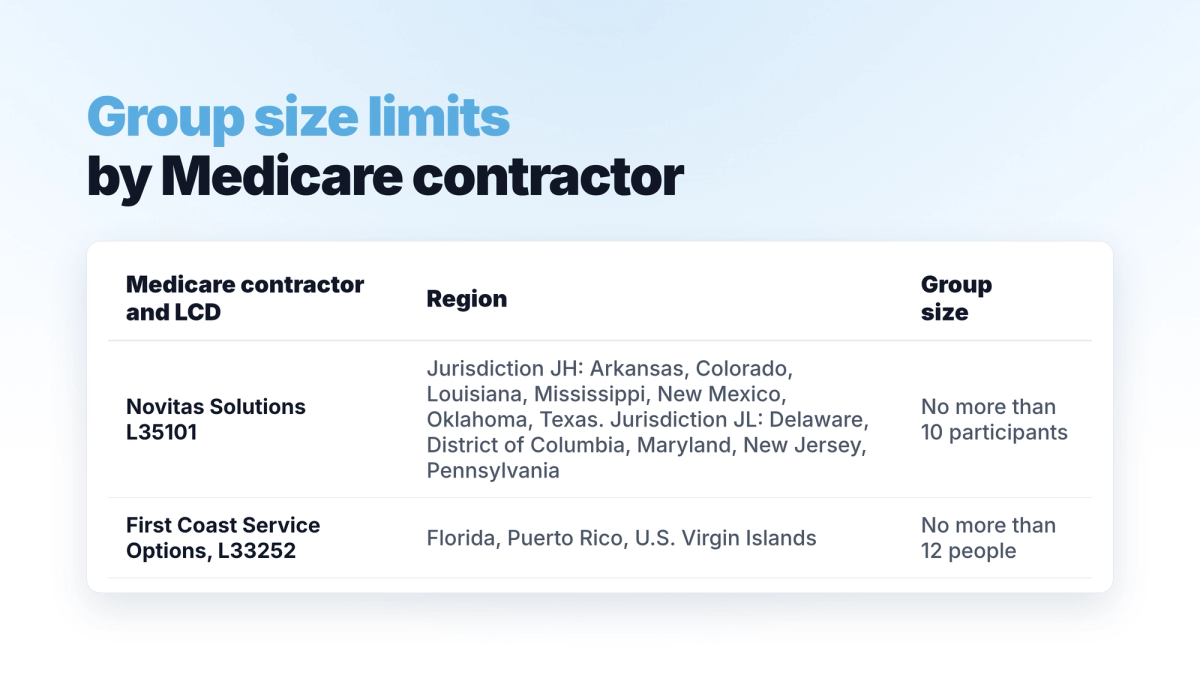
Novitas's policy says a Medicare group should not exceed 10 participants, and First Coast sets a maximum of 12 people. Novitas's policy also says group sessions should be at least 45 to 60 minutes long.
Are group therapy notes psychotherapy notes under HIPAA?
HIPAA's definition of psychotherapy notes covers a mental health professional's notes on the conversation in a group, joint, or family counseling session, as long as the notes are kept separate from the rest of the client's record. The same definition excludes session start and stop times, the modalities and frequency of treatment, and any summary of diagnosis, treatment plan, symptoms, or progress to date, so the session length and progress that Medicare contractors ask for fall outside it.
Under that definition, a clinician's private notes on what members said in a group or family session count as psychotherapy notes only if they are stored separately from each client's chart.
Should a family share one record?
A psychologist may keep a single record when a family is the identified client, according to theAPA's 2007 record keeping guidelines. When treatment starts, a clinician can tell clients, as part of informed consent, whether she keeps the record jointly or separately and who can authorize its release.
The American Group Psychotherapy Association's practice guidelines note that a clinician cannot guarantee confidentiality in a group, and they describe setting out its limits in the informed consent and reviewing them again whenever a new member joins.
Can a clinician write one group note for every client on My Best Practice?
Yes. A clinician on My Best Practice can write one note for a group or family session and have it placed in every relevant client chart, for sessions held in person or on telehealth. A clinician can run a group telehealth session with up to 16 participants, and each participant gets a separate link and appointment reminder.
After a group session, the clinician who led it may want to compare each client's chart with the Novitas format: a shared note with the session's date, length, and key issues and no other member's name, and an addendum on that client's participation and any change in status.
Open a 14-day free trial and write your next group note in it.
Disclaimer: This post is for general information only. It does not provide legal, ethical, or clinical guidance, and it is not a substitute for advice from an attorney, your licensing board, your professional association, or a qualified clinical supervisor or consultant. The Medicare, HIPAA, and professional association sources described here apply to specific regions, payers, and settings, and they may not apply to your practice or may have changed since this post was written. Before making decisions about your staff, your compliance obligations, or client care, consult the appropriate professionals.
References
- Access of individuals to protected health information, 45 C.F.R. § 164.524 (2026). https://www.ecfr.gov/current/title-45/subtitle-A/subchapter-C/part-164/subpart-E/section-164.524
- American Group Psychotherapy Association. (n.d.). Practice guidelines for group psychotherapy. https://agpa.org/practice-guidelines/
- American Psychological Association. (2007). Record keeping guidelines. American Psychologist, 62(9), 993-1004. https://doi.org/10.1037/0003-066X.62.9.993
- Centers for Medicare & Medicaid Services. (2025). List of Medicare telehealth services, calendar year 2026. https://www.cms.gov/files/zip/list-telehealth-services-calendar-year-2026.zip
- Centers for Medicare & Medicaid Services. (2026, March). Medicare & mental health coverage (MLN1986542). https://www.cms.gov/files/document/mln1986542-medicare-mental-health.pdf
- Definitions, 45 C.F.R. § 164.501 (2026). https://www.ecfr.gov/current/title-45/subtitle-A/subchapter-C/part-164/subpart-E/section-164.501
- First Coast Service Options. (2020). Psychiatric diagnostic evaluation and psychotherapy services (LCD L33252). Centers for Medicare & Medicaid Services, Medicare Coverage Database. https://www.cms.gov/medicare-coverage-database/view/lcd.aspx?lcdid=33252
- My Best Practice. (n.d.). Features. https://www.mbpractice.com/features
- My Best Practice. (n.d.). Frequently asked questions. https://www.mbpractice.com/faqs-frequently-asked-questions/
- My Best Practice. (n.d.). Pricing and insurance. https://www.mbpractice.com/pricing-and-insurance/
- My Best Practice. (2024, August 9). 7 elements of the best mental health progress notes. https://www.mbpractice.com/blog/7-elements-of-the-best-mental-health-progress-notes/
- Novitas Solutions. (2024). Psychiatric codes (LCD L35101). Centers for Medicare & Medicaid Services, Medicare Coverage Database. https://www.cms.gov/medicare-coverage-database/view/lcd.aspx?lcdid=35101
- U.S. Department of Health and Human Services. (n.d.). Minimum necessary requirement. https://www.hhs.gov/hipaa/for-professionals/privacy/guidance/minimum-necessary-requirement/index.html
- Uses and disclosures of protected health information: General rules, 45 C.F.R. § 164.502 (2026). https://www.ecfr.gov/current/title-45/subtitle-A/subchapter-C/part-164/subpart-E/section-164.502