
By Dr. J. Ryan Fuller
Photo by Polina Zimmerman on Pexels
Most clinicians I know believe in measuring outcomes. Far fewer do it consistently. In my experience, that gap is rarely about values. It is usually about workflow.
The research tells a similar story. A major review in JAMA Psychiatry defines measurement-based care (MBC) as routinely assessing symptoms during clinical encounters to guide treatment planning (Lewis et al., 2019). The same review reports that fewer than 20% of practitioners engage in MBC. As few as 5% use it on the every-session schedule the evidence supports (Jensen-Doss et al., 2018).
This guide walks through what MBC is, why it tends to stall, and how an EHR might remove most of the friction. It is written with group practices in mind, but a solo clinician can use every step. If you want a primer first, see our overview of routine progress monitoring in therapy, or explore the My Best Practice features built for outcome measurement.
What Measurement-Based Care Is, and What It Is Not
MBC is more than a questionnaire at intake and another at discharge. Lewis et al. (2019) separate MBC from simple outcome monitoring by its schedule. Measures are given consistently, at each or a majority of sessions, and the results directly inform care decisions. Jacqueline Persons and colleagues define progress monitoring in similar terms: using a written or online tool at the start of each session to assess symptoms and/or functioning, then using that information to guide treatment (Persons et al., 2016).
How the data are used matters too. The same review notes added benefit when both clinician and client understand the data, view patterns over time, and use scores to make decisions together (Lewis et al., 2019). This is one of the most important recommendations I hope you take from reading this. We know that progress monitoring improves outcomes. And we know clients are more inclined to willingly complete routine outcome measures (ROMs) when their therapist reviews the scores regularly with them. We really need to develop this as a habit if we want to optimize our care of our clients.
MBC is also not tied to one therapy model. Scott and Lewis (2015) describe it as having both transtheoretical and transdiagnostic relevance. That matters in practices where clinicians use CBT, DBT, ACT, ERP, or other evidence-based approaches.
What the Research Suggests MBC Can Do
The evidence base is substantial. Lewis et al. (2019) summarize 21 randomized clinical trials that compared MBC with usual care. They report that MBC is associated with a lower likelihood of patient decline during treatment. Outcomes improved most for patients who were not responding as expected.
Scores offer a second signal, one that does not depend on how a session “felt.”
When the Scores Surprised Me
In my own practice, scores have surprised me more than once, and not always in the direction you might expect. Several times, a client's measures showed more satisfaction, meaning, and happiness than I had assumed. That led to earlier conversations about ending treatment or meeting less often.
I see that as a good outcome. My aim is to build independence, not reliance on ongoing sessions with me. Stepping down saves clients time and money. It also opens space for new clients who might not otherwise get care.

Photo by Thirdman on Pexels
Why MBC Stalls in Real Practices
If MBC helps, why is it so rare? The research points to friction more than skepticism.
In one survey study, clinicians held generally positive attitudes toward monitoring and feedback. Yet, only 13.9% reported monthly use of standardized progress measures, while 61.5% said they never used them consistently (Jensen-Doss et al., 2018). The authors point to earlier findings that barriers include resource constraints and added time and paperwork.
Clients face friction too. Lewis et al. (2019) identify response burden as a barrier, especially when results are not discussed or used in treatment.
I Learned This the Hard Way
When I was Director of Research at the Albert Ellis Institute, I introduced standardized routine outcome measurement on a regular basis. It was required. We gave the OQ-45 on paper. At intake, we also assessed areas such as irrational beliefs and satisfaction with life.
It met real resistance from staff. Clients had trouble completing the paper forms. I was responsible for collecting, scoring, and monitoring everything, and for “reminding” staff, and that was a euphemism. We believed it improved the quality of care. It was not always efficient, though.
That experience is a big part of why I wanted to build My Best Practice. Every step that required someone to chase, score, or file a form was a place where MBC could quietly fall apart.
How Your EHR Can Remove the Friction
One finding in the implementation research stands out for practice owners. Lewis et al. (2019) describe a study in which clinicians rarely utilized or discussed scores with patients because the feedback platform was a distinct entity from the electronic health record. When clinicians documented data directly into the EHR, they reported providing measures in 90% of sessions and discussing patient scores in 75% of sessions.
In other words, where the data live may matter as much as which data you collect. Here is how MBC works inside My Best Practice, the platform our clinicians use at New York Behavioral Health, the group practice I co-founded.
I also think it is important to be prepared for client pushback, which is often not said, compliance is just low. We can be proactive though. Consultees frequently ask, “How do we get clients onboard with taking the time to complete ROMs?” The research supports what I’ve seen, which is that clients are open to it when they understand that it isn’t about research I’m doing to publish. It’s researching what is happening in their lives, now, while they are in treatment, so I can, and we can collaboratively improve their care in real time, less stalling, better outcomes faster. We can ask our clients, “Would you want to see a cardiologist who never took your BP, measured your cholesterol, or administered an EKG?”
Step 1: Choose Measures with Strong Psychometric Properties
Start with validated instruments. The PHQ-9 is a good example. A large individual participant data meta-analysis pooled 58 studies with more than 17,000 participants. Among studies that used clinician-administered semi-structured diagnostic interviews, a cutoff of 10 or higher maximized combined sensitivity (0.88) and specificity (0.85) for major depression (Levis et al., 2019).
The My Best Practice library includes measures such as the PHQ-9, GAD-7, OCI-R, AAQ-II, and DERS. Every ROM in the library has solid psychometric properties.
Practices can also build as many of their own measures as they like, at no extra charge. The system sends, reminds, scores, and charts them just like library measures. A practice can even use it to collect the data needed to evaluate the psychometric properties of a questionnaire they developed. If you add a published instrument that is not in the library, make sure your practice holds the license or author permission to use it.
Step 2: Automate the Schedule and the Reminders
Consistency is where many MBC efforts break down. In My Best Practice, clinicians can schedule measures on any custom cadence: three hours before a session, the day after, the third Thursday of each month, or quarterly. Clients get reminders by text or email, so no one on your team has to chase forms.
Step 3: Let Clients Complete Measures Where It Is Easiest
Clients can complete measures in the client portal before a session, during a session, or while they are in the in-person or virtual waiting room.
Step 4: Review Scores in Seconds, Then Discuss Them
My Best Practice scores every measure automatically. One click on the Metrics tab shows a chart and a table of each score over time. When a graph would help a client see their own progress, you can share your screen or drag it into their client portal.
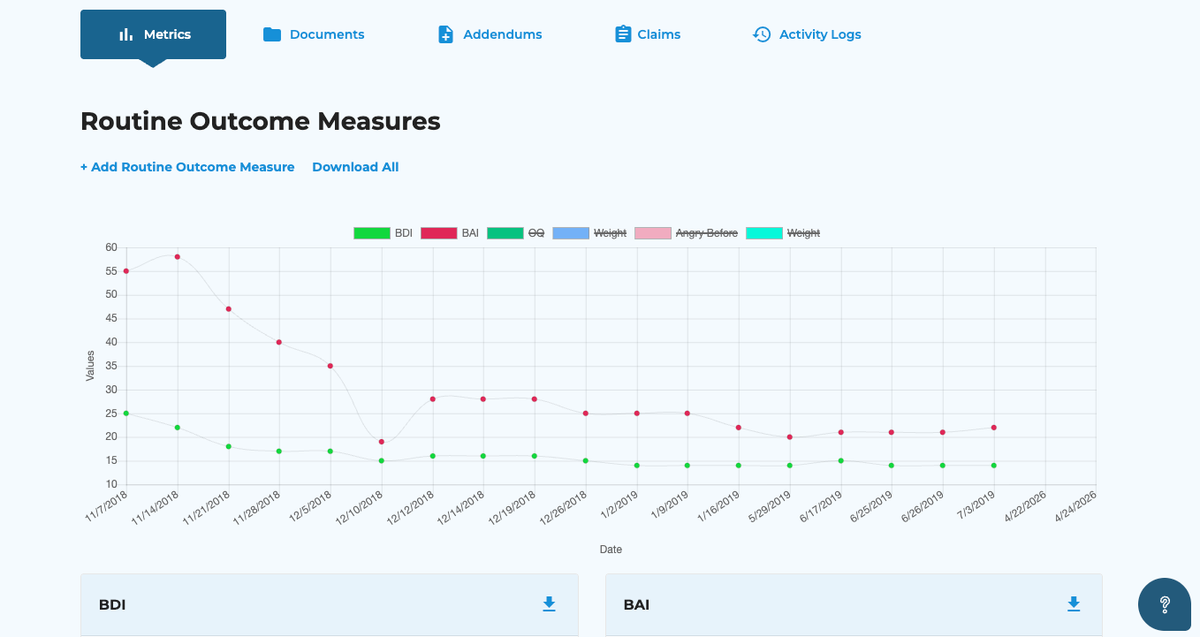
The Metrics tab in My Best Practice: scores charted automatically over time (sample data)
This step is what turns measurement into care. Scott and Lewis (2015) describe a case in which a clinician shared graphs of a client's scores in session. After confirming the scores aligned with the client's reported experience, the clinician reexamined the original case conceptualization and treatment plan.
Step 5: Make Homework Easy to Assign, Track, and Review
In skills-based therapies, homework is part of treatment. A meta-analysis suggests a significant association between homework compliance and treatment outcomes, with a small to medium effect (r = .26; Mausbach et al., 2010).
How clinicians assign homework appears to matter, too. In a study of CBT for adolescent depression, a stronger rationale, more time spent explaining the assignment, and troubleshooting potential barriers predicted improved homework participation at the next session (Jungbluth & Shirk, 2013). I have found it is incredibly clinically useful to identify potential challenges to homework completion and then problem solving. In my experience, it not only increases homework compliance, but reinforces their problems solving skills and enhances self-efficacy. Engagement, in turn, appears to track faster change. In a study of cognitive therapy for depression, sessions in which a client engaged more with homework than usual were followed by greater symptom improvement in subsequent sessions (Conklin & Strunk, 2015).
So, assigning and reviewing homework should take as little effort as possible. In My Best Practice, a repeated assignment can be carried forward to next week with one click, with no retyping, which leaves more session time for explaining the rationale and troubleshooting obstacles. Assignments appear in the client portal, where clients check them off, and completion syncs to the progress note in real time. Each note shows what was assigned last session, so you know what to ask about, and whether the client already marked it complete.
The system also calculates completion rates and charts them over time. In my experience, clinicians find completion rates very useful. Reviewing the chart with a client can be a way to recognize effort and reinforce their sense of self-efficacy. For more on documentation, see our guide to the elements of strong mental health progress notes.
Here is one example from my own practice, offered as clinical experience rather than a research finding. A client had told me directly how valuable homework had been for him. When we looked at his completion chart together, it made a sharp dip very clear, and the dip lined up with a recent drop in his mood and growing frustration with himself. That gave us an entry point. Was low mood reducing his follow-through? Was missed homework stalling his progress? Or were both feeding each other? Whatever the direction, it became the focus of the session, and it helped us turn things around.
Practice-Level Decisions for Group Practice Owners
Build MBC Into Supervision
Supervisors and administrators in My Best Practice can export the full outcome dataset across clinicians and dates, then analyze it however they choose. That can support supervision, quality improvement, and conversations with payers. Our article on building the right team to scale a group practice covers where a clinical director fits in.
As a supervisor, I have found that reviewing these charts can change treatment. Again, this is my experience, not a research finding. On several occasions, a client's self-reported depression scores had not improved, even though sessions gave the therapist the impression that things were going fine. That gap made it important for the therapist to follow up and gently explore it. Sometimes the reason was shame, or a wish not to let the therapist down. Those conversations led to more honest communication. What clients said in session began to match what they reported on their measures, and treatment was able to improve.
Start Small and Build Champions
Implementation strategies named in the research include leveraging local implementation and training leadership (Lewis et al., 2019). Training paired with an easy tool can help, too. When Persons and colleagues gave 26 psychotherapists an online progress-monitoring tool plus training, their use of progress monitoring rose significantly, and a year later they were still using some form of it (Persons et al., 2016). In practice, that might mean piloting one or two measures with a few willing clinicians before a practice-wide rollout. For more on rollouts, see implementing evidence-based modalities at scale.
The Bottom Line
MBC has strong research support and low real-world use. The research suggests the gap is largely about friction: time, paperwork, and tools that sit outside the clinical workflow. When measures are sent, scored, and charted automatically inside the EHR, MBC might finally become part of everyday care rather than one more task.
About the Author
Dr. J. Ryan Fuller is a cognitive behavioral therapist and co-founder of My Best Practice, an EHR built for behavioral health clinicians, and of New York Behavioral Health. He trained under Albert Ellis and served as the first Director of Research of the Albert Ellis Institute. His clinical work spans ACT, DBT, ERP, REBT, Schema Therapy, and traditional behavior therapies. He has co-authored research on anger treatment outcomes published in Behavioural and Cognitive Psychotherapy, and his commentary has appeared in the Wall Street Journal, the New York Times, ABC & NBC News, Good Morning America, etc. His work focuses on where evidence-based clinical practice meets health technology.
References
Conklin, L. R., & Strunk, D. R. (2015). A session-to-session examination of homework engagement in cognitive therapy for depression: Do patients experience immediate benefits? Behaviour Research and Therapy, 72, 56-62. https://doi.org/10.1016/j.brat.2015.06.011
Jensen-Doss, A., Becker Haimes, E. M., Smith, A. M., Lyon, A. R., Lewis, C. C., Stanick, C. F., & Hawley, K. M. (2018). Monitoring treatment progress and providing feedback is viewed favorably but rarely used in practice. Administration and Policy in Mental Health and Mental Health Services Research, 45(1), 48-61. https://doi.org/10.1007/s10488-016-0763-0
Jungbluth, N. J., & Shirk, S. R. (2013). Promoting homework adherence in cognitive-behavioral therapy for adolescent depression. Journal of Clinical Child & Adolescent Psychology, 42(4), 545-553. https://doi.org/10.1080/15374416.2012.743105
Lewis, C. C., Boyd, M., Puspitasari, A., Navarro, E., Howard, J., Kassab, H., Hoffman, M., Scott, K., Lyon, A., Douglas, S., Simon, G., & Kroenke, K. (2019). Implementing measurement-based care in behavioral health: A review. JAMA Psychiatry, 76(3), 324-335. https://doi.org/10.1001/jamapsychiatry.2018.3329
Levis, B., Benedetti, A., Thombs, B. D., & DEPRESsion Screening Data (DEPRESSD) Collaboration. (2019). Accuracy of Patient Health Questionnaire-9 (PHQ-9) for screening to detect major depression: Individual participant data meta-analysis. BMJ, 365, l1476. https://doi.org/10.1136/bmj.l1476
Mausbach, B. T., Moore, R., Roesch, S., Cardenas, V., & Patterson, T. L. (2010). The relationship between homework compliance and therapy outcomes: An updated meta-analysis. Cognitive Therapy and Research, 34(5), 429-438. https://doi.org/10.1007/s10608-010-9297-z
Persons, J. B., Koerner, K., Eidelman, P., Thomas, C., & Liu, H. (2016). Increasing psychotherapists' adoption and implementation of the evidence-based practice of progress monitoring. Behaviour Research and Therapy, 76, 24-31. https://doi.org/10.1016/j.brat.2015.11.004
Scott, K., & Lewis, C. C. (2015). Using measurement-based care to enhance any treatment. Cognitive and Behavioral Practice, 22(1), 49-59. https://doi.org/10.1016/j.cbpra.2014.01.010