
A practice owner who signs with an electronic health record (EHR) company trusts it with the practice's client records. Before signing, the owner can look up who owns that company and ask how long the contract lasts. Some EHR companies say on their own sites that they are privately owned. An owner who chooses My Best Practice does not commit to a multi-year contract and can cancel anytime from the Subscription tab.
Which mental health EHRs are not owned by private equity or venture capital?
On its own site, TherapyAppointment says it is privately owned and that no outside investors set its quarterly targets or determine its priorities, and CarePaths says it remains a privately held company. SimplePractice and Valant each appear on a private equity firm's list of its companies, and so does Ensora Health, which offers TheraNest. We have not confirmed any other company's ownership ourselves.
My Best Practice is owned by its two founders. We have not taken private equity or venture capital money.
| EHR | What the company or its investor has published |
|---|---|
| CarePaths | On its own site, CarePaths says it remains a privately held company. |
| My Best Practice | My Best Practice is owned by its two founders. No private equity or venture capital funding. |
| SimplePractice | Vista Equity Partners lists SimplePractice as a current company on its page titled Vista's Private Equity Portfolio. In a press release on Vista's site, EngageSmart announced that an affiliate of Vista had acquired it, and the release names SimplePractice among EngageSmart's products. |
| TheraNest | Ensora Health offers a free trial of TheraNest on its own site. KKR lists Ensora Health in its portfolio under the asset class Private Equity. |
| TherapyAppointment | On its own site, TherapyAppointment says it is independent and privately owned. |
| Valant | Resurgens Technology Partners announced its investment in Valant in a release on Valant's own site, where Resurgens is described as a software-focused private equity firm. Resurgens lists Valant with the status Current. |
What researchers have studied about private equity ownership in health care
Researchers have studied private equity ownership of the organizations that deliver care, but no study we cite looked at a company that makes EHR software (Borsa et al., 2023; Zhu et al., 2024).
In Colorado, Texas, and North Carolina, private equity firms owned about one in four mental health facilities, Zhu and colleagues found (Zhu et al., 2024). Across the United States the share was 6.2%, but the researchers say their acquisition data may be incomplete.
Where researchers measured what payers or the people receiving care paid, costs were higher at care organizations owned by private equity in 9 of 12 studies (Borsa et al., 2023). Three found no difference, and none found lower costs. Those 12 were among the 55 studies that Borsa and colleagues reviewed, most often studies of nursing homes, followed by hospitals and dermatology settings (Borsa et al., 2023). The review describes private equity firms as buying companies with investors' capital and large amounts of debt, and as generally seeking to sell them within three to five years. The 27 studies that assessed the quality of care were split: 12 found harmful impacts, 3 found beneficial ones, and 12 found mixed or neutral ones. But the reviewers call these results associations, and they rated none of the studies they assessed at low risk of bias.
These studies cannot tell an owner how any EHR company will act, because none of them looked at one. We read them as a reason for an owner to ask each vendor who owns the company and who has invested in it, and to check the answer on the investor's own site.
What a practice owner can check before signing with any EHR vendor
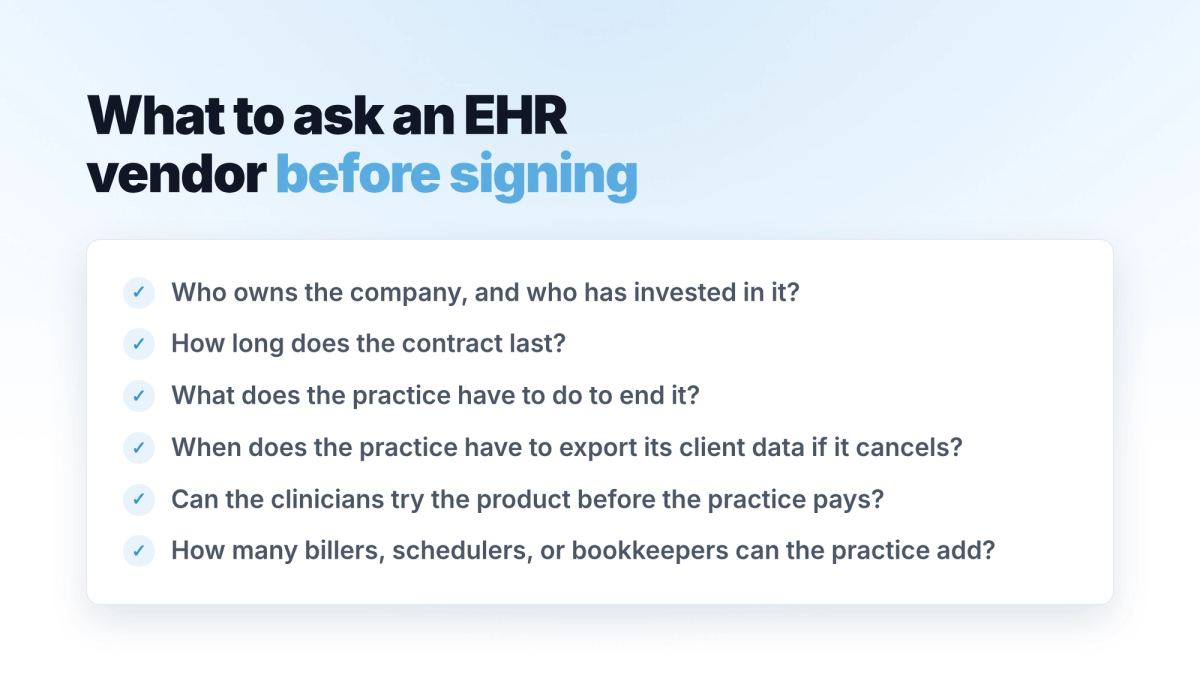
A practice owner can ask a vendor who owns the company and who has invested in it. The owner can ask how long the contract lasts, what the practice has to do to end it, and when the practice has to export its client data if it cancels. Before the practice pays, the owner can ask whether the clinicians can try the product, and how many billers, schedulers, or bookkeepers the practice can add.
After one U.S. health care system moved to a single vendor's EHR, someone at the vendor had to make many of the changes that staff used to make themselves, a leader there told researchers (Brunner et al., 2023). The leader called that dependency frustrating. We think a group practice depends in the same way on the company that keeps its client records. Brunner and colleagues interviewed staff at four health care systems, but they say their findings generate hypotheses and do not test them. They suggest that an institution could write its contract with an EHR vendor so that it keeps its autonomy in the areas most important to it.
We wrote about what happened when hospitals changed from one EHR to another in another post.
What a practice owner agrees to with My Best Practice
My Best Practice costs $39 a month for the first clinician and $19 for each additional one. A practice can add as many schedulers, billers, or bookkeepers as it needs. A practice can pay for telehealth month to month without a contract, and a provider who goes on leave can pause telehealth and stop the charges.
An owner who chooses My Best Practice does not commit to a multi-year contract and pays no setup fee. My Best Practice signs a Business Associate Agreement (BAA) with every practice. The owner can cancel anytime from the Subscription tab by pressing Cancel Subscription. Before canceling, an owner can export the client data the practice needs and email our support team for a complete export of the account's data.
What a clinician can do in My Best Practice
A clinician can write a custom note from any theoretical perspective, e.g., cognitive behavioral therapy (CBT), dialectical behavior therapy (DBT), acceptance and commitment therapy (ACT), or rational emotive behavior therapy (REBT), or a universal template or templates available to every provider. A clinician can send a client the PHQ-9, GAD-7, PCL-5, or any of the more than 100 routine outcome measures included, with reminders, on any cadence, scored and charted automatically in the Metrics tab. A clinician who opens a note can see the session agenda items brought forward from the previous appointment and the homework assigned to the client. A DBT practice can open a Diary Card the client has completed from the My Best Practice Library. From the To Do List, a supervisor can open a supervisee's notes and sign or countersign them. We want to make best practices easy.
Try My Best Practice free for 14 days, no credit card needed.
Disclaimer: This post is for general information only. It does not provide legal, ethical, or clinical guidance, and it is not a substitute for advice from an attorney, your licensing board, your professional association, or a qualified clinical supervisor or consultant. The studies described here were done in health care systems, nursing homes, hospitals, dermatology settings, and behavioral health practices, not at software companies, and their findings may not apply to your practice. Before making decisions about your staff, your compliance obligations, or client care, consult the appropriate professionals.
References
- Borsa, A., Bejarano, G., Ellen, M., & Bruch, J. D. (2023). Evaluating trends in private equity ownership and impacts on health outcomes, costs, and quality: systematic review. BMJ, 382, e075244. https://doi.org/10.1136/bmj-2023-075244
- Brunner, J., Anderson, E., Mohr, D. C., Cohen-Bearak, A., & Rinne, S. T. (2023). From "local control" to "dependency": Transitions to single-vendor integrated electronic health record systems and their implications for the EHR workforce. Journal of General Internal Medicine, 38(Suppl 4), 1023-1030. https://doi.org/10.1007/s11606-023-08281-6
- Singh, Y., Cantor, J., Fuse Brown, E., & Whaley, C. (2025). Private equity penetration in behavioral health in the United States, 2010-2022. Journal of General Internal Medicine, 40(7), 1690-1692. https://doi.org/10.1007/s11606-024-09218-3
- Zhu, J. M., Greenberg, E., King, M., & Busch, S. (2024). Geographic penetration of private equity ownership in outpatient and residential behavioral health. JAMA Psychiatry, 81(7), 732-735. https://doi.org/10.1001/jamapsychiatry.2024.0825