
When a clinic ran a dialectical behavior therapy (DBT) skills group by video call alongside one in a clinic room, the video group's members came more often, to 91% of sessions, compared with 75% for the group that met in person (Lopez et al., 2020). They felt as connected to the facilitator as the in-person members did, and less connected to one another (Lopez et al., 2020). That is the trade-off a group practice weighs when it moves sessions online, and the rest of the evidence is reassuring. Across nine randomized trials of 1,268 people with depression, clients improved about as much by phone or video as in person, and were about as satisfied with their care (Scott et al., 2022). The other half of the decision is paperwork, because HHS writes that the HIPAA Rules require a Business Associate Agreement (BAA) with any telehealth vendor that does more than carry health information. On My Best Practice, which signs a BAA with every practice, a clinician can schedule, hold, document, and bill a video session for a whole group from one calendar, with one note the system adds automatically to each member's individual chart, which saves therapists a lot of time and reduces their stress.
EHR with a BAA and built-in telehealth for groups
My Best Practice signs a Business Associate Agreement (BAA) with every practice. Telehealth is a $20 a month add-on for each clinician, and as many as 16 people can join one telehealth session. An owner can enroll each clinician who will hold video sessions in the Staff & Users area, or turn on a practice setting that lets clinicians enroll themselves. A scheduler who books the appointment can assign telehealth instead of an in-person appointment. The client receives an email reminder with their own link before the appointment, and the clinician can send the link again from the appointment if that is ever necessary. At the appointment time, the clinician can start the video from the calendar, see when the client has arrived, use a waiting room, and share a screen or open a chat box during the session.
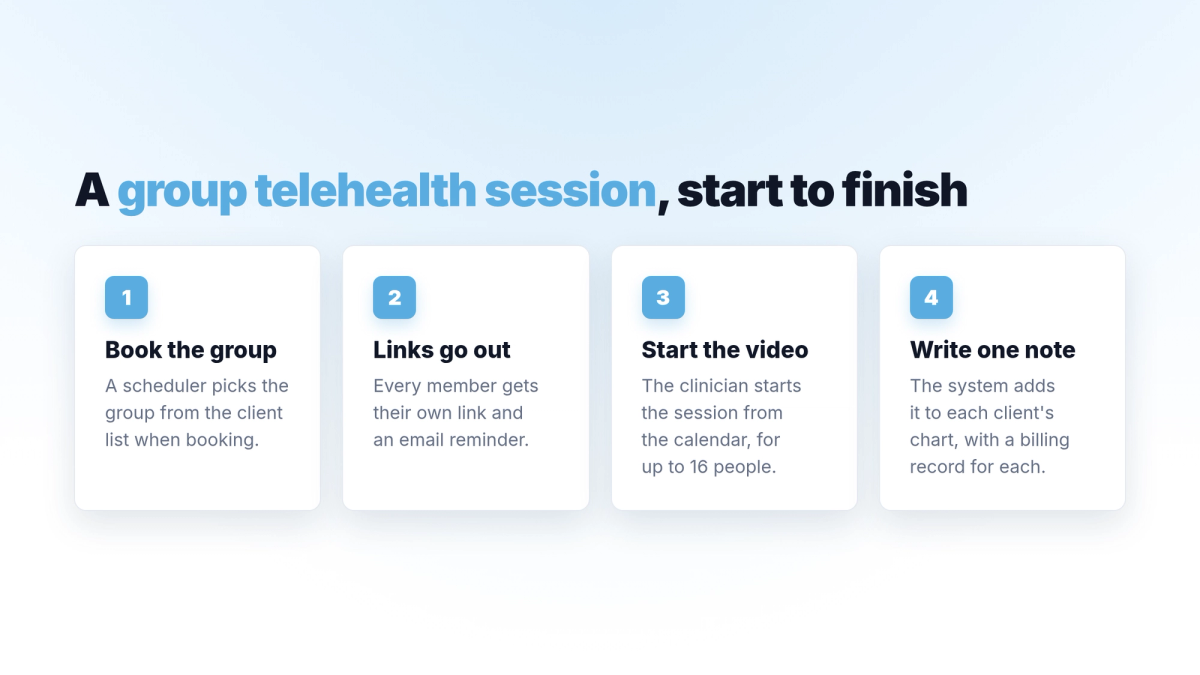
For a group, a scheduler can pick the group from the client list when booking, and every member gets their own link and reminder. After the session, the clinician can write one note, and the system adds the group note description automatically to each client's individual chart. The clinician can also amend any other notes taken for each individual. The system adds a billing record for each participant as appropriate. After an eligible telehealth session, a therapist who uses AI Progress Notes can open, edit, and sign the draft if they choose. The same button works for an in-person session, after the clinician checks that the computer's microphone picks up both voices. AI Progress Notes cost $2 per note or $60 per month per professional for an unlimited number of notes. Either option needs the telehealth add-on, and a clinician can start or cancel the monthly plan in any month. Both add-ons can even be turned on and off as needed, e.g., if a therapist is going away for the month of August.
SimplePractice includes telehealth in every plan, with group telehealth on its Plus plan. TherapyNotes includes Basic Telehealth for one-on-one sessions in every plan, and its Premium Telehealth, at $15 a month per clinician, holds up to 16 participants, including the clinician. Sessions Health sells a telehealth add-on for up to 4 participants.
What HHS says about a BAA for a telehealth vendor
The Department of Health and Human Services (HHS) writes that a company is, generally, a business associate when it performs functions or services on a practice's behalf that involve creating, receiving, maintaining, or transmitting Protected Health Information (PHI). HHS counts a company that only carries PHI, like the postal service, as a conduit instead. In its telehealth guidance, HHS writes that the HIPAA Rules require a BAA with any telecommunication vendor that does more than carry PHI as a conduit, and its example is an app that keeps session recordings or transcripts in the developer's cloud. HHS says the COVID-era allowance for sessions over ordinary video-chat apps ended in 2023. In its notice, HHS told providers who want more privacy protection to use vendors that will sign a BAA.
Does therapy over video work as well as in person?
For symptoms, the pooled trials have found no difference between phone or video and in-person care (Greenwood et al., 2022; Scott et al., 2022). Symptom severity after treatment was about the same by phone or video as in person across seven pooled trials of clients with less common conditions (Greenwood et al., 2022). That review found no eligible trials for schizophrenia, bipolar disorder, or personality disorders (Greenwood et al., 2022).
One result was less reassuring. Clients in a meta-analysis of videoconference psychotherapy rated their relationship with the therapist, which researchers call the working alliance, lower by video than face-to-face (Norwood et al., 2018). The uncertainty around that result was wide enough that the authors could not call video as good as face-to-face on the alliance, though symptoms improved about as much either way (Norwood et al., 2018). Across 29 studies of 2,143 clients, another meta-analysis found that clients would be as satisfied with tele-mental health as with in-person care if technology problems were kept to a minimum (Mazziotti & Rutigliano, 2021).
Clients also missed fewer telehealth appointments (Cuthbert et al., 2022). At one CBT clinic, clients missed 12.8% of 27,249 in-person individual therapy appointments and 9.9% of 6,436 telehealth appointments, by audio or video (Cuthbert et al., 2022). The study did not measure whether telehealth changed outcomes (Cuthbert et al., 2022).
Does group therapy work over video?
In one DBT-based dual-diagnosis intensive outpatient program (IOP), 49 clients completed the program in person and 20 by video (Bean et al., 2022). Depression scores fell in both formats, the drop did not differ between them, and neither did the number of sessions missed (Bean et al., 2022). The DBT skills-group comparison had 15 clients by video and 20 in person (Lopez et al., 2020). Neither study randomized clients to a format (Bean et al., 2022; Lopez et al., 2020). A clinician can hold group, couples, family, and individual sessions over telehealth on My Best Practice.
What does telehealth cost for a group practice?
Telehealth costs $20 a month for each clinician who uses it, on top of $39 a month for the first clinician, then $19 a month for each one after.
| Clinicians | Core EHR | Every clinician on telehealth |
|---|---|---|
| 5 | $115 | $215 |
| 10 | $210 | $410 |
| 15 | $305 | $605 |
| 20 | $400 | $800 |
Monthly subscription at list prices; billing plans, AI Progress Notes, e-prescribing, card processing, and migration cost extra.
Does the free trial include telehealth?
Yes. In the 14-day free trial, a practice can use almost every part of the EHR, including telehealth, at no cost and with no credit card (e-scripts and the clearinghouse are not accessible during the trial). During the trial, a clinician can hold telehealth sessions in a live account and write notes, book appointments, open the client portal, and bill from the same account. After the trial, a practice pays for telehealth month to month with no contract, and a clinician on leave can pause it without ongoing telehealth charges. A practice pays no setup fee and signs no multi-year contract.
A practice of ten clinicians pays $410 a month when every clinician holds telehealth sessions, before add-ons. An owner can add an eleventh clinician for $19 a month, or $39 with telehealth.
Put your clinicians on telehealth in a 14-day free trial.
Disclaimer: This post is for general information only. It does not provide legal, ethical, or clinical guidance, and it is not a substitute for advice from an attorney, your licensing board, your professional association, or a qualified clinical supervisor or consultant. The studies described here were done in specific settings, and their findings may not apply to your practice. Before making decisions about your staff, your compliance obligations, or client care, consult the appropriate professionals.
References
- Bean, C. A. L., Aurora, P., Maddox, C. J., Mekota, R., & Updegraff, A. (2022). A comparison of telehealth versus in-person group therapy: Results from a DBT-based dual diagnosis IOP. Journal of Clinical Psychology, 78(11), 2073-2086. https://doi.org/10.1002/jclp.23374
- Cuthbert, K., Parsons, E. M., Smith, L., & Otto, M. W. (2022). Acceptability of telehealth CBT during the time of COVID-19: Evidence from patient treatment initiation and attendance records. Journal of Behavioral and Cognitive Therapy, 32(1), 67-72. https://doi.org/10.1016/j.jbct.2022.01.001
- Greenwood, H., Krzyzaniak, N., Peiris, R., Clark, J., Scott, A. M., Cardona, M., Griffith, R., & Glasziou, P. (2022). Telehealth versus face-to-face psychotherapy for less common mental health conditions: Systematic review and meta-analysis of randomized controlled trials. JMIR Mental Health, 9(3), e31780. https://doi.org/10.2196/31780
- Lopez, A., Rothberg, B., Reaser, E., Schwenk, S., & Griffin, R. (2020). Therapeutic groups via video teleconferencing and the impact on group cohesion. mHealth, 6, 13. https://doi.org/10.21037/mhealth.2019.11.04
- Mazziotti, R., & Rutigliano, G. (2021). Tele-mental health for reaching out to patients in a time of pandemic: Provider survey and meta-analysis of patient satisfaction. JMIR Mental Health, 8(7), e26187. https://doi.org/10.2196/26187
- My Best Practice. (n.d.). AI Notes. https://www.mbpractice.com/ai-notes
- My Best Practice. (n.d.). Features. https://www.mbpractice.com/features
- My Best Practice. (n.d.). Frequently asked questions. https://www.mbpractice.com/faqs-frequently-asked-questions/
- My Best Practice. (n.d.). Pricing and insurance. https://www.mbpractice.com/pricing-and-insurance/
- My Best Practice. (2026, October 28). My Best Practice vs. TherapyNotes for group practices. https://www.mbpractice.com/blog/my-best-practice-vs-therapynotes-group-practices/
- My Best Practice. (2026, October 30). How to write group therapy notes for every client in the group. https://www.mbpractice.com/blog/how-to-write-group-therapy-notes-for-every-client/
- My Best Practice Support Center. (n.d.). Telehealth start to finish. https://mbpracticesupport.zohodesk.com/portal/en/kb/articles/telehealth-start-finish
- Norwood, C., Moghaddam, N. G., Malins, S., & Sabin-Farrell, R. (2018). Working alliance and outcome effectiveness in videoconferencing psychotherapy: A systematic review and noninferiority meta-analysis. Clinical Psychology & Psychotherapy, 25(6), 797-808. https://doi.org/10.1002/cpp.2315
- Scott, A. M., Clark, J., Greenwood, H., Krzyzaniak, N., Cardona, M., Peiris, R., Sims, R., & Glasziou, P. (2022). Telehealth v. face-to-face provision of care to patients with depression: A systematic review and meta-analysis. Psychological Medicine, 52(14), 2852-2860. https://doi.org/10.1017/S0033291722002331
- Sessions Health. (n.d.). Pricing. https://www.sessionshealth.com/pricing
- SimplePractice. (n.d.). Pricing. https://www.simplepractice.com/pricing/
- TherapyNotes. (n.d.). HIPAA-compliant telehealth. https://www.therapynotes.com/features/telehealth/
- U.S. Department of Health and Human Services, Office for Civil Rights. (n.d.). Business associates frequently asked questions (FAQs). https://www.hhs.gov/hipaa/for-professionals/privacy/guidance/business-associates/index.html
- U.S. Department of Health and Human Services, Office for Civil Rights. (n.d.). Guidance on how the HIPAA Rules permit covered health care providers and health plans to use remote communication technologies for audio-only telehealth. https://www.hhs.gov/hipaa/for-professionals/privacy/guidance/hipaa-audio-telehealth/index.html
- U.S. Department of Health and Human Services, Office for Civil Rights. (n.d.). HIPAA and telehealth. https://www.hhs.gov/hipaa/for-professionals/special-topics/telehealth/index.html
- U.S. Department of Health and Human Services, Office for Civil Rights. (n.d.). Notification of enforcement discretion for telehealth remote communications during the COVID-19 nationwide public health emergency. https://www.hhs.gov/hipaa/for-professionals/special-topics/emergency-preparedness/notification-enforcement-discretion-telehealth/index.html