
Understanding Selective Mutism with MBP Users Bianca Levy, PhD and Danya Schlussel, PsyD
A parent comes in and says, “I don’t understand why Jimmy won’t talk at school! He loves playing games with his siblings and we practice our letters together every day. Why is he being like this? I could tell he was nervous when I dropped him off on the first day of kindergarten, but why hasn’t he spoken at all yet?” This may be a confusing narrative for a clinician who is unfamiliar with the diagnosis, but it is a common story we hear from parents of kids with Selective Mutism.
Selective Mutism (SM) is a complex anxiety disorder where a child consistently fails to speak in specific social situations, most often at school, despite being capable of speaking comfortably in other environments, like at home.
It can be a confusing experience for parents who see their child as talkative and bubbly at home, only to be shocked when a teacher reports they haven’t uttered a single word in class. Sometimes, SM’s effects can be limited to a child’s interactions with certain individuals (e.g., a teacher or waiters) or to certain spaces (e.g., the school building).
It is easy to misinterpret the signs of SM. Parents often describe their children as "shy," and some may even think that their child is being oppositional or "difficult" by refusing to respond when they are clearly capable of talking elsewhere.
However, SM is distinct from typical shyness. Shy children generally warm up to new situations over time. Unlike shy children, those with SM remain unable to speak even after they have become comfortable in a setting. In fact, SM cannot be diagnosed during the first month of school, as this is considered a natural "warm-up" period for many kids.
SM vs. Social Anxiety
While SM and social anxiety frequently co-occur, there is a key behavioral difference. Children who have SM without broader social anxiety often participate fully in non-verbal ways. For instance, a child with SM might happily run around with peers on the playground even if they can't talk to them. In contrast, a child with social anxiety may not play with other kids, or might be too afraid to get up in the middle of class to use the bathroom for fear of being noticed. While children with SM can have co-occurring social anxiety, they can also have SM without additional social anxiety symptoms.
Treatment Options
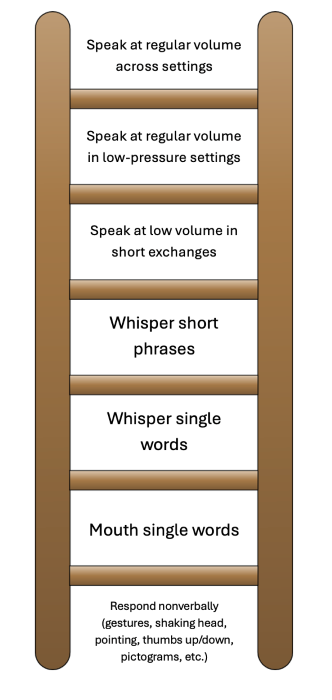
The "gold standard" for treating SM is behavioral therapy using exposure techniques. Initially, therapists use play therapy skills to build confidence and encourage speech in the therapist’s office. Then, therapists work with families to develop a goal ladder. This is a list of feared situations ranked based on the level of distress it causes. The therapist puts this information into a visual hierarchy to which they can refer back to as treatment progresses. For some children with SM, a ladder may look like talking with the parent in an empty classroom, then talking with the parent while a teacher is sitting in the corner, then responding directly to the teacher, and so on. For a child with severe selective mutism the initial goals might be to communicate nonverbally, for instance by using pictograms or gestures, and move toward whispering single words. This ladder climbing continues until the child is able to speak with a regular voice in all settings.
Another key component of treatment is parent and teacher training. Parents and teachers have the greatest influence over the child's daily environment and by changing how caregivers respond to the child’s anxiety, caregivers can directly influence how the child learns to handle difficult situations. One of the most effective forms of treatment is called Parent Child Interaction Therapy adapted for Selective Mutism (PCIT-SM), which combines caregiver training with the behavioral exposure therapy. The therapy teaches caregivers unique skills to help grow children’s comfort and confidence, reduce avoidance cycles, and target verbal exposures.
School-based interventions, such as 504 accommodation plans, and medication management may also be important in cases where behavioral therapy alone is not sufficient.
In some cases, symptoms of SM may disappear on their own. However, it is highly recommended to seek intervention as soon as possible. If left untreated, SM can lead to academic impairments or create safety concerns because children cannot effectively communicate their needs to teachers or other adults around them. Additionally co-occurring symptoms of social anxiety often remain and can even persist into adulthood. At Gordon Therapy Group, we have multiple therapists who are specially trained in evaluating and treating individuals with SM. If you have concerns or questions about your child, please reach out for a consultation.