
Dr. Stephen Terracciano shows his clients a graph of their outcome scores over time. By the time he does, they have often already felt the change. Seeing their progress on the graph impresses them, and they feel good about the work they have put into treatment. Tracking progress this way is what the research recommends, and it can help clinicians give better care.
My own clients' scores have caught me off guard more than once. A few times, a client rated their satisfaction with life well above what I had hypothesized from our discussions.
Which EHR does a board-certified CBT psychologist use?
Dr. Stephen Terracciano has used My Best Practice for more than five years. He is board-certified in behavioral and cognitive psychology, runs a solo practice, and calls My Best Practice his administrative assistant.
Dr. Stephen Terracciano's practice at a glance:
| Practice | Intentional Living Psychological Services, PLLC |
|---|---|
| Offices | Manhattan and Scarsdale, Westchester County, New York |
| Clinicians | 1 (solo practice) |
| Board certification | American Board of Professional Psychology, behavioral and cognitive psychology |
| Main approaches | CBT and Acceptance and Commitment Therapy; MBCT (Mindfulness-Based Cognitive Therapy) for prevention of depressive recurrence; Cognitive Processing Therapy for PTSD; CBT for Body Dysmorphic Disorder; Imago Relationship Therapy for couples |
| Using My Best Practice since | More than 5 years |
How does a CBT psychologist set treatment goals with clients?
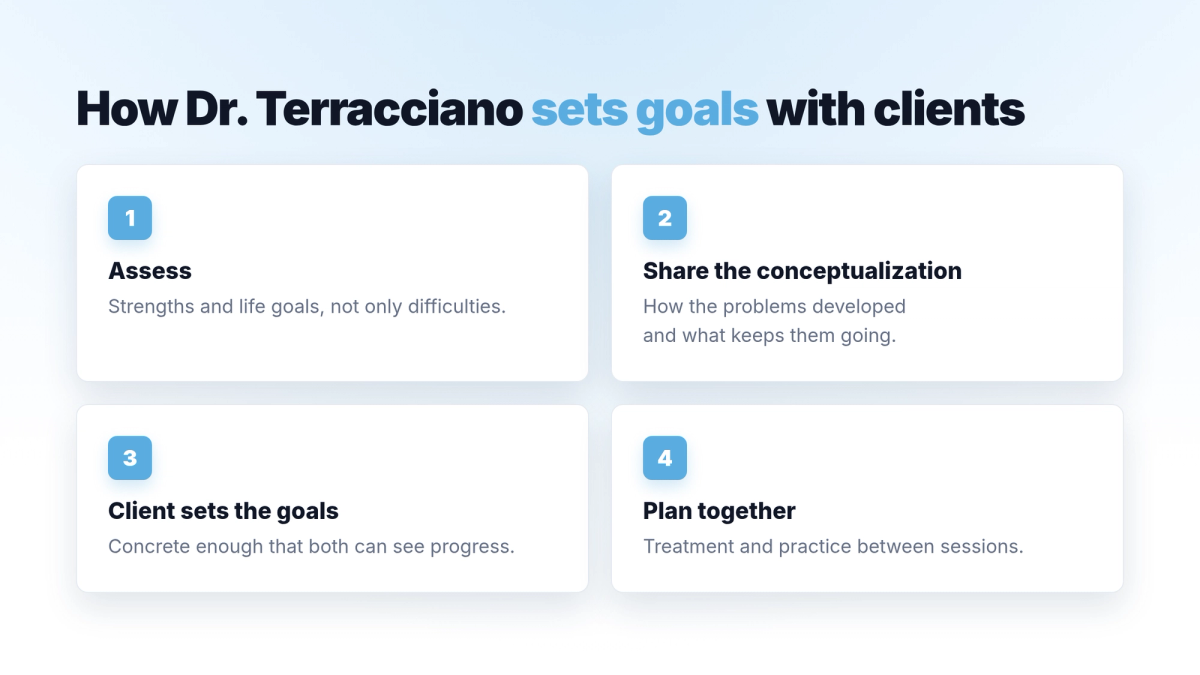
Dr. Terracciano does not rush to goals. He spends what can be a few sessions on assessment, because he wants to know a client's strengths and life goals along with their difficulties. He wants treatment to improve the client's quality of life, not merely reduce symptoms and distress. After assessment, he engages in collaborative treatment planning with clients by sharing his conceptualization of how their problems have developed, what factors are maintaining them, and how cognitive and behavioral treatment methods could help.
Only then are goals set, and the client sets them. Dr. Terracciano's part, as he describes it, is to help make a goal concrete enough that both of them can tell what progress looks like. I made the same case in my post on therapy treatment plans, where I recommended writing a goal so that either person can tell by observation whether it has been met. Operationalizing goals like this is critically important, in my opinion, making it much easier later to understand whether they are being met or not.
I think the workflow he uses, i.e., starting with a thorough assessment, case conceptualization, and then collaboratively setting goals, is what many of us strive to do.
He takes the time to discuss clients' strengths with them. A client who has just heard their strengths described may be more likely to set a goal about how they want to live. From there, they plan treatment and the practices the client will do between sessions.
How does ACT help clients who cope by distracting themselves?
Ask clients how they are coping with a hard week, and many will tell you they distract themselves. Dr. Terracciano hears it often, from scrolling social media to playing video games while at work. He turns it around for them: "The distraction is your self-defeating behavior." The scrolling that was supposed to ease the pain is what pulls them away from what is most important in their lives. He teaches clients about the pain of absence, the pain we have when we are deprived of things that are most meaningful to us.
Clients also tell him their goal is to be less anxious, and he is honest with them that a feeling cannot be switched off on request. While changing the way they think can change an emotion, very often it helps more to learn how to allow intense feelings and learn from them, because emotions carry information. He calls himself a mindfulness-based practitioner, and describes Acceptance and Commitment Therapy (ACT) as a form of CBT. In session, that means mindfulness, acceptance of unpleasant experiences, and taking valued actions to improve psychological flexibility.
Pooled across 39 randomized trials, clients who received ACT improved more than clients in control conditions (g = 0.57), a moderate effect by the usual benchmarks (A-Tjak et al., 2015). In the 9 trials that compared ACT with established treatments such as CBT, the authors found no significant difference (A-Tjak et al., 2015). ACT has a lot of scientific support for numerous conditions (Gloster et al., 2020).
How does CBT treat Body Dysmorphic Disorder?
Dr. Terracciano describes Body Dysmorphic Disorder (BDD) as a condition of perceived ugliness and a preoccupation with appearance flaws that are not significant, or non-existent. A client may camouflage the feature or get caught in front of the mirror inspecting it and lose a lot of time. Some people pull back from social contact, or start working from home to avoid the office. It causes a lot of suffering. Dr. Terracciano has specialized in it for many years, treats it with CBT, finds CBT effective, and would love to start a BDD group for clients.
Across 7 randomized trials of CBT built for BDD, clients improved far more than those on a waitlist or receiving a credible placebo (delta = -1.22), which is a large difference (Harrison et al., 2016). Not every client responded. In the four trials that counted responders, 40% to 54% met responder criteria (Harrison et al., 2016). Those are the clients whose scores I would watch most closely, because a flat line is an early sign that the plan needs to change.
A two-site trial of 120 adults compared therapist-delivered CBT for BDD with supportive psychotherapy. CBT appeared to give more consistent improvement, while the results of supportive psychotherapy varied by site (Wilhelm et al., 2019). CBT held steady at both sites, which favors a protocol written for the disorder.
How does Cognitive Processing Therapy help clients with PTSD?
For PTSD, Dr. Terracciano uses Cognitive Processing Therapy (CPT), a twelve-session protocol in which clients identify and challenge their stuck points in thinking about the causes of their traumatic events. Much of his trauma work is with survivors of sexual abuse and sexual assault, and he finds it gratifying to watch clients break through symptoms that can take over their lives.
A stuck point is a belief about the trauma that conflicts with other beliefs, skips steps in its logic, or rests on an unexamined assumption (Resick et al., 2002). In the version of CPT tested in one trial, clients wrote an account of the trauma, and the therapist used it to find those beliefs (Resick et al., 2002). The trial enrolled 171 women with chronic PTSD after rape, and the authors found CPT and Prolonged Exposure both highly efficacious and better than a waiting condition (Resick et al., 2002). Of everyone assigned to CPT, including the women who did not finish, 53% no longer met criteria for PTSD after treatment (Resick et al., 2002). The trial included only women after rape, so it says less about other survivors.
How does Imago Relationship Therapy approach couples in conflict?
With couples, Dr. Terracciano steps outside a strictly cognitive-behavioral model. He uses Imago Relationship Therapy and received his Imago Relationship Therapist certification in 2007. Imago draws on attachment theory and on adaptations partners overlearned in childhood that may no longer benefit their current intimate relationship.
Dr. Terracciano helps couples conceive of conflict as a chance for growth, instead of pointing fingers and thinking things will only get better once the other changes. When one partner is dissatisfied, he asks the other to hear it as an invitation to grow into an underdeveloped part of themselves. This makes their partner happier, so both of them benefit.
Where can clients find a CBT therapist for Body Dysmorphic Disorder or PTSD in Manhattan and Westchester?
Dr. Stephen Terracciano sees clients in person in Manhattan and in Scarsdale, Westchester County, and by telehealth, and he treats Body Dysmorphic Disorder with CBT and PTSD with Cognitive Processing Therapy. He treats a spectrum of mood, anxiety, and behavioral disorders for adults throughout the lifespan. Since completing his doctorate in 2000, he has provided CBT to the LGBTQ community on issues specific to sexual and gender identity and expression. In addition, he helps performing, visual, and literary artists to overcome blocks to creativity, and helps entrepreneurial women grow their businesses. For creatives and business owners alike, a lot of treatment involves taking risks to overcome self-doubt in order to grow professional self-esteem. He guides clients in the use of exposure therapy: taking actions that have been avoided to find that feared outcomes usually do not happen. Clinicians who want to refer a client can reach him through Intentional Living Psychological Services, PLLC.
What does a solo CBT practice use its EHR for every day?
Dr. Terracciano is in My Best Practice every day for scheduling, progress notes, and the online intake documents and consent forms new clients complete before treatment starts. His billing and treatment planning are there too, and he finds his documentation and administrative work simpler and faster for it. He has customized his clinical documentation, and he rates the customer service as excellent. From a broad range of clinical measures, he picks the ones that track each client's symptoms and progress and sends them to the client.
As a co-founder of My Best Practice, I have a stake in what follows. Back when I was the director of research at the Albert Ellis Institute, we had clients fill out the Outcome Questionnaire-45 (OQ-45) by hand, and I scored and tracked every form myself with an outdated Scantron machine and reminded the staff to give them to clients, which was a generous description of what I did. Now, with My Best Practice, a clinician can send the PHQ-9, GAD-7, PCL-5, or any of the more than 100 routine outcome measures (ROMs) with reminders, on any cadence, scored and charted automatically in the Metrics tab, which is much easier and more efficient than how I began. We built the measures into My Best Practice because we want best practices to be easy.
Dr. Terracciano's clients are not the only ones who feel encouraged by their graphs. Clients in a Norwegian study described the same effect (Solstad et al., 2021). In interviews with 12 people at a specialist mental health clinic, most described seeing their own scores and progress as a source of hope and encouragement, though some found it demoralizing (Solstad et al., 2021). Their therapists usually printed the reports, and the clients said the reports needed to be discussed with them (Solstad et al., 2021). That is why I would go through the graph with the client. The therapists chose who took part, and they may have picked clients who were doing well (Solstad et al., 2021). A meta-analysis of 58 studies, covered in our post on routine outcome monitoring, found that progress feedback had a small effect on symptoms and dropout (de Jong et al., 2021).
Few of us would keep seeing a cardiologist who skipped the blood pressure cuff, and clients deserve the same from us. If you want to try this, at the next session after a score has moved, turn the screen toward the client and ask what they notice. When a score gets worse, ask the client what changed. A client who wants to please the therapist may also describe a better week than the scores show, and I would ask about the difference. When there has been improvement, connect it to their behaviors so they can be reinforced for their own hard work and gain a sense of control, increasing their self-efficacy.
Try My Best Practice free for 14 days, no credit card needed.
Disclaimer: This post is for general information only. It does not provide legal, ethical, or clinical guidance, and it is not a substitute for advice from an attorney, your licensing board, your professional association, or a qualified clinical supervisor or consultant. The studies described here were done in specific settings, and their findings may not apply to your practice. Before making decisions about your compliance obligations or client care, consult the appropriate professionals. Dr. Terracciano is a My Best Practice user and was interviewed for this post.
About the author
Dr. J. Ryan Fuller is Chief Clinical Officer at My Best Practice. A licensed clinical psychologist, Dr. Fuller specializes in Cognitive Behavioral Therapy (CBT), practice management innovation for group behavioral health practices, and executive coaching. He was the Director of Research at the Albert Ellis Institute and the Director of Behavior for the Obesity Research Center Weight Loss Program in the Columbia Department of Medicine. He has published peer-reviewed research on anger treatment outcomes, irrational beliefs, interpersonal relationships and happiness, and loneliness and obesity. He also founded New York Behavioral Health, a private-pay group practice. Dr. Fuller has been featured on Good Morning America, ABC World News with Diane Sawyer, and Katie Couric's talk show, and in The New York Times and The Wall Street Journal, and he serves as an expert consultant for group practice technology and clinical implementation. His clinical and business expertise spans behavioral health technology, practice operations, and the intersection of evidence-based clinical work and sustainable business models. He regularly consults with growing group practices on scaling, clinical leadership, and financial modeling.
References
- A-Tjak, J. G., Davis, M. L., Morina, N., Powers, M. B., Smits, J. A., & Emmelkamp, P. M. (2015). A meta-analysis of the efficacy of acceptance and commitment therapy for clinically relevant mental and physical health problems. Psychotherapy and Psychosomatics, 84(1), 30-36. https://doi.org/10.1159/000365764
- de Jong, K., Conijn, J. M., Gallagher, R. A., Reshetnikova, A. S., Heij, M., & Lutz, M. C. (2021). Using progress feedback to improve outcomes and reduce drop-out, treatment duration, and deterioration: A multilevel meta-analysis. Clinical Psychology Review, 85, Article 102002. https://doi.org/10.1016/j.cpr.2021.102002
- Fuller, J. R. (2026, November 5). What should be in a therapy treatment plan. My Best Practice. https://www.mbpractice.com/blog/what-should-be-in-a-therapy-treatment-plan/
- Gloster, A. T., Walder, N., Levin, M. E., Twohig, M. P., & Karekla, M. (2020). The empirical status of acceptance and commitment therapy: A review of meta-analyses. Journal of Contextual Behavioral Science, 18, 181-192. https://doi.org/10.1016/j.jcbs.2020.09.009
- Harrison, A., Fernández de la Cruz, L., Enander, J., Radua, J., & Mataix-Cols, D. (2016). Cognitive-behavioral therapy for body dysmorphic disorder: A systematic review and meta-analysis of randomized controlled trials. Clinical Psychology Review, 48, 43-51. https://doi.org/10.1016/j.cpr.2016.05.007
- My Best Practice. (2025, January 15). How to run routine outcome monitoring in a group practice. https://www.mbpractice.com/blog/routine-progress-monitoring-in-therapy/
- Resick, P. A., Nishith, P., Weaver, T. L., Astin, M. C., & Feuer, C. A. (2002). A comparison of cognitive-processing therapy with prolonged exposure and a waiting condition for the treatment of chronic posttraumatic stress disorder in female rape victims. Journal of Consulting and Clinical Psychology, 70(4), 867-879. https://doi.org/10.1037/0022-006X.70.4.867
- Solstad, S. M., Kleiven, G. S., & Moltu, C. (2021). Complexity and potentials of clinical feedback in mental health: An in-depth study of patient processes. Quality of Life Research, 30(11), 3117-3125. https://doi.org/10.1007/s11136-020-02550-1
- Wilhelm, S., Phillips, K. A., Greenberg, J. L., O'Keefe, S. M., Hoeppner, S. S., Keshaviah, A., Sarvode-Mothi, S., & Schoenfeld, D. A. (2019). Efficacy and posttreatment effects of therapist-delivered cognitive behavioral therapy vs supportive psychotherapy for adults with body dysmorphic disorder: A randomized clinical trial. JAMA Psychiatry, 76(4), 363-373. https://doi.org/10.1001/jamapsychiatry.2018.4156