
In 2018, researchers pooled 54 studies covering 7,278 therapy clients and found that clients who agreed with their therapist on the goals of therapy tended to have better outcomes.
Before My Best Practice, I worked in settings where a clinician was fortunate if a treatment plan was kept in a Word document, and I was troubled to find that some clinicians may not have been up to date on their progress notes. Because keeping a plan took so much effort, many clinicians neglected steps they needed to take. In my view, that weakened clinical care, and the stress of it raised burnout among the staff.
What should be in a therapy treatment plan?
A therapy treatment plan should hold goals the client and clinician agree on, written so both can tell when each is met. I recommend operationalizing them, i.e., defining them in a way that it can easily be determined by observation whether they have been met. Interventions can be detailed underneath the goals. It is also a good idea to include the frequency and duration of each, the outcome measure(s) for each goal, the homework, and a date to review the plan.
| Part of the plan | What the research or rule states |
|---|---|
| Goals the client and clinician agree on | 54 studies, 7,278 clients: clients who agreed with their therapist on goals tended to do better (r = .24) |
| Collaboration on the work of therapy | 53 studies, 5,286 clients: clients who worked with their therapist as collaborators tended to do better (r = .29) |
| Measurable goals for each client | A 1968 paper said broad goals for a whole program had given no workable framework for evaluating the program, and proposed a measurable scale for each client's goal, set before treatment |
| Interventions, frequency, expected duration | Expected in First Coast's Medicare LCD for Florida, Puerto Rico, and the U.S. Virgin Islands; check your own contractor and commercial payers |
| Outcome measures reviewed with the client | 51 articles reviewed; virtually all trials with frequent feedback to the provider during the session improved outcomes |
| Homework | In cognitive and behavioral therapy, controlled studies of the same therapy with and without homework favored homework (d = 0.48), in a 46-study meta-analysis |
| Periodic review | Updated generally at least every three months under First Coast's Medicare LCD |
A plan can also hold a case formulation, the clinician's working account of what maintains the client's problems. A 2018 review of 24 studies of case formulation in CBT (Cognitive Behavioral Therapy) found that experienced therapists can construct some parts of a formulation reliably, but that no study has yet shown it makes CBT more effective. While this is the case, I personally find case conceptualization to be critical to my process of treatment planning and even specific choices about when to utilize which particular interventions in session. I believe being thoughtful about which mechanisms are being targeted is clinically useful, and case conceptualization is a framework that supports this kind of process-oriented approach. An EHR that provides case conceptualization supports this strategy.
Should the client help set treatment plan goals?
Yes, a collaborative approach for many aspects of therapy is something I recommend. In a 2018 meta-analysis, agreement on goals correlated with outcome at r = .24, which its authors call a medium effect. Agreement on goals is one part of the working alliance, and a separate 2018 meta-analysis of 295 studies found the same kind of link between the alliance and outcome in face-to-face therapy (r = .28). Establishing, maintaining, and of course increasing the therapeutic alliance can only help us provide optimal care. The authors of the goal paper recommend that therapists ask for the client's input to form the goals and the plan, give the client regular feedback, and keep the client involved throughout therapy.
Among the limitations the authors list are that the studies assessed agreement at a single time during treatment and that their analyses do not permit causal conclusions. The correlations cannot tell us whether agreeing on goals helps clients improve or whether clients who are improving agree more readily. Even without proof of cause, I recommend writing goals with the client.
In person-centered care planning, as the authors of a 2021 trial define it, the clinician and client build the plan together, starting from the client's most valued life goals. In a 2013 trial at 10 community mental health centers, the centers trained in it and in collaborative documentation saw more clients take their medication as prescribed and about a quarter lower odds of a missed appointment.
How to write a measurable goal in a treatment plan
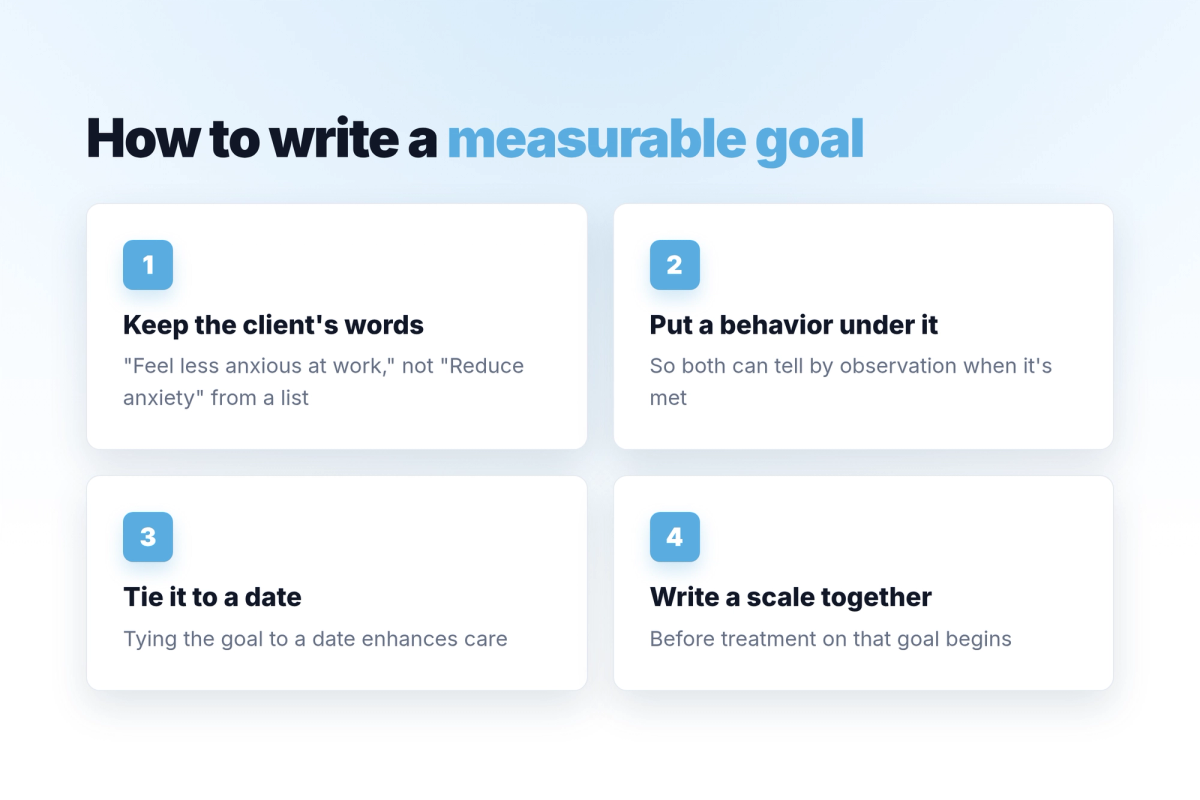
Write each goal so that the clinician and the client could both easily tell whether it has been met.
Goal Attainment Scaling, proposed in 1968, set up a measurable scale for each client-therapist goal before treatment began. Its authors wrote that broad mental health goals set for a whole program had not provided a workable framework for evaluating it.
Suppose a client says they want to feel less anxious at work. Reducing anxiety is the goal a clinician might pick from a list. The clinician can keep the client's words as the goal and put a behavior and a date under it, with a scale the clinician and client write together before treatment on that goal begins. Operationalizing it and tying it to a date enhances care.
What do Medicare contractors expect in a psychotherapy treatment plan?
This section is a general summary of two Medicare documents, not billing, legal, or compliance advice. Medicare's local coverage determinations (LCDs) are written by regional contractors, and each one applies only to Medicare claims in that contractor's region.
As I read it, LCD L33252, written by First Coast Service Options for Florida, Puerto Rico, and the U.S. Virgin Islands, expects an outpatient psychotherapy plan to include measurable and objective goals, the interventions, the frequency of sessions, and the estimated duration of treatment, and expects the plan to be updated generally at least every three months. It also asks for periodic documentation of the methods of monitoring outcomes and why the chosen therapy fits.
A second contractor, Wisconsin Physicians Service, in LCD L34616, asks for a periodic summary of goals, progress toward them, and an updated treatment plan in the record.
First Coast's list asks for measurable goals and methods of monitoring outcomes, two parts that the research on goals and feedback supports. Before changing a plan template, an owner whose practice bills Medicare can look up the LCD for the practice's own contractor in the CMS Medicare Coverage Database, and an owner who bills commercial insurers can ask each payer for its documentation requirements for psychotherapy.
Requirements differ by contractor and payer and can change, so check the current version of any LCD before relying on this summary.
Why outcome measures should be reviewed with the client in session
A 2017 review of 51 articles found that virtually all randomized trials with frequent and timely feedback of client-reported symptoms to the provider during the session improved outcomes, while one-time screening, infrequent measurement, and feedback given outside the session did not. A 2018 meta-analysis of 24 studies found that feedback reduced deterioration and, among clients predicted to do poorly, nearly doubled the rate of reliable or clinically significant change. My guide to measurement-based care explains how to choose the measures, and the post on routine progress monitoring explains how monitoring helps a therapist make timely adjustments when an intervention is not working.
Review the client's scores during the session with the plan open, because that is where the feedback research found its effect. Tie each measure to a goal in the plan, so that when the clinician and client look at the score together, they are looking at progress on something the client said mattered when they collaboratively set goals.
Should homework be part of a treatment plan?
Yes, there is a lot of scientific support for assigning and checking homework. A 2010 meta-analysis of 46 studies of cognitive and behavioral therapy compared the same therapy with and without homework in its controlled studies and found a pooled effect of d = 0.48 favoring homework. Its authors concluded that homework assignments enhance therapy outcomes. Write the homework under the goal it serves, so the clinician and client can check it against that goal at the next session.
Why treatment plan goals should be written as free text
A 2019 study of clinics implementing person-centered planning found that some clinics could not individualize service plans in their electronic health record, that drop-down boxes and pre-determined outcomes were barriers to person-centered care, and that clinic staff customized their records or built workarounds. The authors concluded that the record needs to let clinicians individualize plans and orient them to the client's personal life goals.
Because drop-down boxes were one of the barriers that the study found, I would make sure the person in charge of customizing them is made aware of the study. There are individual differences, and I think in this case, it depends on the practice, clinicians, and clients. Being aware of what may be true overall for practices is important. Then, carefully thinking about the optimal way to design the treatment plan is what I would recommend.
How a clinician can keep a treatment plan in My Best Practice
I co-founded My Best Practice, so read this section knowing that.
When we built My Best Practice, I wanted a clinician to be able to write progress notes and treatment plans and collect routine outcome measures in the same system. A clinician can write treatment plans in My Best Practice alongside their progress notes. The clinician can see agenda items carried forward from one appointment to the next, track the client's homework with a completion percentage, and have outcome measures scheduled automatically, sent to clients to complete before sessions, scored, and shown on a chart.
A clinician can modify the note templates or build custom questionnaires and intake forms, and every provider in the practice can use the custom templates. Clinical notes and treatment plans come with the core EHR at $39 a month for the first professional and $19 for each additional one, and an unlimited number of administrators are always free.
How to write a treatment plan your clinicians will use
Here is what I would tell a practice owner rewriting the group practice's treatment plan template. Put the goal fields first and make them free text, with the client's words in them. Give each goal a scale written at the start of treatment, an outcome measure the client completes before sessions, and the homework that serves it. Fill in the interventions, the frequency, and the expected number of sessions, and set a review date no more than three months out.
Start a 14-day free trial and write your next treatment plan in it.
About the author
Dr. J. Ryan Fuller is Chief Clinical Officer at My Best Practice. A licensed clinical psychologist, Dr. Fuller specializes in Cognitive Behavioral Therapy (CBT), practice management innovation for group behavioral health practices, and Executive Coaching. He was the Director of Research at the Albert Ellis Institute, Director of Behavior for the Obesity Research Center Weight Loss Program in the Columbia Department of Medicine, and has published peer-reviewed research on anger treatment outcomes, irrational beliefs, interpersonal relationships and happiness, and loneliness and obesity. He also founded New York Behavioral Health, a private-pay group practice. Dr. Fuller has been featured on Good Morning America, ABC World News with Diane Sawyer, Katie Couric, and in The New York Times and serves as an expert consultant for group practice technology and clinical implementation. His clinical and business expertise spans behavioral health technology, practice operations, and the intersection of evidence-based clinical work and sustainable business models. He regularly consults with growing group practices on scaling, clinical leadership, and financial modeling.
References
- Easden, M. H., & Kazantzis, N. (2018). Case conceptualization research in cognitive behavior therapy: A state of the science review. Journal of Clinical Psychology, 74(3), 356-384. https://doi.org/10.1002/jclp.22516
- First Coast Service Options, Inc. (2020). Psychiatric diagnostic evaluation and psychotherapy services (Local Coverage Determination L33252). Centers for Medicare & Medicaid Services. https://www.cms.gov/medicare-coverage-database/view/lcd.aspx?lcdid=33252
- Flückiger, C., Del Re, A. C., Wampold, B. E., & Horvath, A. O. (2018). The alliance in adult psychotherapy: A meta-analytic synthesis. Psychotherapy, 55(4), 316-340. https://doi.org/10.1037/pst0000172
- Fortney, J. C., Unützer, J., Wrenn, G., Pyne, J. M., Smith, G. R., Schoenbaum, M., & Harbin, H. T. (2017). A tipping point for measurement-based care. Psychiatric Services, 68(2), 179-188. https://doi.org/10.1176/appi.ps.201500439
- Fuller, J. R. (2026, September 29). Measurement-based care in mental health: An implementation guide for your EHR. My Best Practice. https://www.mbpractice.com/blog/measurement-based-care-implementation-guide-ehr/
- Kazantzis, N., Whittington, C., & Dattilio, F. M. (2010). Meta-analysis of homework effects in cognitive and behavioral therapy: A replication and extension. Clinical Psychology: Science and Practice, 17(2), 144-156. https://doi.org/10.1111/j.1468-2850.2010.01204.x
- Kiresuk, T. J., & Sherman, R. E. (1968). Goal attainment scaling: A general method for evaluating comprehensive community mental health programs. Community Mental Health Journal, 4(6), 443-453. https://doi.org/10.1007/BF01530764
- Lambert, M. J., Whipple, J. L., & Kleinstäuber, M. (2018). Collecting and delivering progress feedback: A meta-analysis of routine outcome monitoring. Psychotherapy, 55(4), 520-537. https://doi.org/10.1037/pst0000167
- Stanhope, V., Choy-Brown, M., Williams, N., & Marcus, S. C. (2021). Implementing person-centered care planning: A randomized controlled trial. Psychiatric Services, 72(6), 641-646. https://doi.org/10.1176/appi.ps.202000361
- Stanhope, V., Ingoglia, C., Schmelter, B., & Marcus, S. C. (2013). Impact of person-centered planning and collaborative documentation on treatment adherence. Psychiatric Services, 64(1), 76-79. https://doi.org/10.1176/appi.ps.201100489
- Stanhope, V., & Matthews, E. B. (2019). Delivering person-centered care with an electronic health record. BMC Medical Informatics and Decision Making, 19(1), Article 168. https://doi.org/10.1186/s12911-019-0897-6
- Tryon, G. S., Birch, S. E., & Verkuilen, J. (2018). Meta-analyses of the relation of goal consensus and collaboration to psychotherapy outcome. Psychotherapy, 55(4), 372-383. https://doi.org/10.1037/pst0000170
- Wisconsin Physicians Service Insurance Corporation. (2025). Psychiatry and psychology services (Local Coverage Determination L34616). Centers for Medicare & Medicaid Services. https://www.cms.gov/medicare-coverage-database/view/lcd.aspx?lcdid=34616