
In 2012, UK researchers published what they found after contacting every team in the country trained in DBT between 1994 and 2007 and sorting them into two piles: still running the program or not.
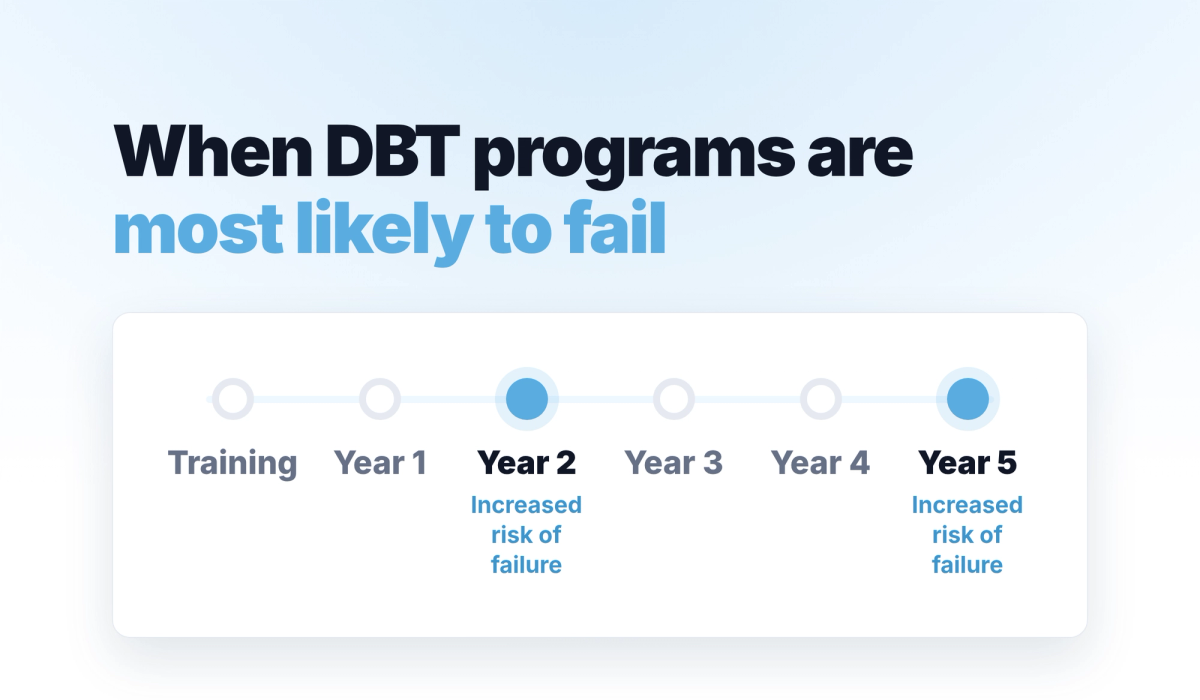
The program ran the highest risk of stopping in its second year after training, and again in its fifth. Ask a practice owner what it took to start a DBT program and you will hear about the training. Keeping the program running is a different challenge, maybe even a tougher one. I equate it to losing weight. Losing weight is hard, but for many, it’s very doable. Maintaining weight loss for years is rare.
When asked what made the program hard to keep running, the teams named staff turnover and no support from the organization most often.
Intensive DBT involves four components. It requires individual therapy, a skills group, phone coaching between sessions, and a weekly consultation group for the therapists, which DBT calls the consultation team.
DBT programs are labor-intensive. They require a lot of time and typically take an emotional toll on the staff, depending on the clients served. In addition, DBT consultation meetings and coaching calls don’t bring in revenue. So they are costly to run.
How do I implement DBT with fidelity across a group practice?
You run all four parts of the treatment, you protect the two that produce no session fee with the same scheduling discipline you give billable hours, and you have the program's adherence checked against the model rather than against your own impression of it.
I wrote in September, in a guide to implementing evidence-based modalities at scale, that DBT needs more supervision infrastructure than any of the other modalities in that guide.
A 2017 survey of 59 Veterans Health Administration sites that had put DBT in place found that 42% ran all four parts of the treatment: individual therapy, a skills group, phone coaching between sessions, and weekly DBT consultation team meetings. The skills group was the component that was run most often. 59% offered phone coaching in some form, and of those, 11% offered it at all hours. Providers were often given little or no time for the work, and the barrier sites found hardest was coaching calls outside business hours.
The DBT-Linehan Board of Certification certifies individual clinicians and whole programs against the model as it was researched, with criteria built from Linehan's two 1993 manuals and from the research on adherence coding. A practice can apply to have its program certified.
What one trial learned by removing the skills group

Which of the four modes can a program drop?
A 2015 trial randomized 99 women with borderline personality disorder (BPD), each with at least two suicide attempts or self-injury acts in the previous five years, to a year of treatment and a year of follow-up in three conditions: standard DBT, skills training plus case management, and DBT individual therapy plus an activities group, with the dose held constant and every provider using DBT's suicide risk protocol.
All three conditions reduced suicide attempts, and by similar amounts. The two conditions that included skills training did better during the treatment year on self-injury and on depression than the condition without it, and standard DBT held on to more clients: 24% dropped out, against 48% in the condition without skills training.
A program that cannot staff a skills group but runs individual DBT with the risk protocol loses the skills-training effect on self-injury and depression, and its dropout rate might double. What the trial does not tell us is what happens when the consultation team goes, because it was not designed to test that. A program that keeps its group and its individual sessions and loses its consultation team in year two has lost a mode none of the trials in this post removed, and probably for a very good reason. That component seems to be necessary to keep the team focused, reasonably healthy, and able to keep up adherence.
The reason to care about retention is in the older trial, which randomized 101 women with borderline personality disorder and recent suicidal and self-injurious behavior to a year of DBT or a year of community treatment by experts. The women in DBT were half as likely to make a suicide attempt. They were also less likely to drop out and had fewer psychiatric hospitalizations. The authors concluded the difference could not reasonably be attributed to the general factors of expert psychotherapy.
Why DBT programs fail in the second year
Picture a composite of the program the surveys describe. In year one, the owner sends everyone to an intensive training, the skills group starts, and the consultation team meets every week because the trainer said it had to. In year two, two clinicians leave, the meeting slides to every other week, then to monthly, and by spring nobody is sure it is still a DBT program. That composite is an assumption rather than a finding, and I will come back to it.
The UK teams in the 2012 study named two problems most often: no support from their organization and staff turnover. Six years later, the same group published a second study. Practitioner turnover and financing were the barriers cited most often, and teams trained off-site were more likely to survive than teams trained on-site, a large effect the authors call tentative because the two groups' data were not equally complete.
Another study interviewed 19 clinicians over 13 months while a public behavioral health system rolled out DBT, and three themes came back: program development and recruiting clients, a lack of administrative support or organizational investment, and the time DBT asks of a clinician. The authors discuss strategies to prevent drift, among them a train-the-trainer model. The owner of the program the surveys describe spent the training money in year one, on people, and when the people left in year two, the organization had bought nothing else: no clinician who could train the replacements and no budget line for the meeting.
Why the consultation team matters for DBT adherence
A 2015 survey of 79 clinicians who had completed intensive DBT training counted the DBT elements each was delivering. Four team variables correlated with that count: cohesion, communication, climate, and supervision. Among clinicians who had all had the same intensive training, it was the team variables that tracked how much of the treatment was being delivered, and because the survey is a snapshot, it cannot say which way the arrow points.
A 2022 survey of 65 DBT therapists asked about burnout. Therapists on consultation teams they rated as more effective reported less of it, as did therapists on teams that shared phone consultation among members; more crisis contacts went with more burnout, and calls about generalizing skills did not. Two cautions belong next to that. It is one survey, taken at one point in time, and sharing the calls across a team is an adaptation: in the model as Linehan wrote it, between-session coaching belongs to the client's individual therapist. A practice that shares the phone for the burnout reason should know it is trading adherence for sustainability. A hospital's morning handoff is the closest institutional analogy I know, with one correction. Nobody bills for the minutes in which the night team tells the day team which client stopped eating, and if an administrator cut those minutes, the ward would look the same for a while and the errors would arrive later, unconnected to the missing meeting. The DBT consultation team has the same economics and a different purpose. Linehan designed it as treatment for the therapists, the weekly hour in which the team keeps each member motivated, in the frame, and adherent, and in which a colleague can notice that someone has drifted toward validation without change. In that program, that hour went to monthly in year two, and nothing in the schedule looked wrong.
What software does for a DBT team
I co-founded an EHR, so read this section knowing that.
The diary card belongs to the individual session. A client fills it in between sessions; the therapist can read it at the start of the next session, and the session agenda follows the target hierarchy shown on the card. That is a clinical act. Around it, a clinician can add her own measures, schedule them on any custom cadence, and read each score charted over time on a Metrics tab, while the client gets the reminder by text. The standing of any measure comes from the instrument, which is why my guide to measurement-based care begins with choosing measures with strong psychometric properties. The chart sits alongside the card the client brings to the room.
The consultation team hour, the coaching phone, and the adherence check belong to people and to the calendar, with someone responsible for checking them.
How to keep a DBT program running after the first year
Here is what I would tell a practice owner to book now, while the training is still fresh.
Book the consultation team for a fixed hour every week and treat it like a client hour, which means it is not cancelled to make room for one, with the obvious exception of a client in crisis. Decide who takes between-session calls. In the model, that is the client's individual therapist; if your answer is a shared rota, which the burnout survey found easier on therapists, write down that you have adapted the model and why. Plan the next training before anyone has resigned, because turnover is among the barriers both UK studies name most often, and because train-the-trainer is one of the ways to prevent drift. Put the program in front of the DBT-Linehan Board of Certification's program criteria. Then write a line in the budget for all of it, because financing is the other barrier the UK teams named most. And book the same review again at the start of year five, because the UK study found a second dip there.
The program the surveys describe will reach year two whatever the owner does. Two clinicians will leave, and the meeting will come under pressure to slide. Whether it is still DBT at month twenty depends on decisions that were made, or not made, at month one, when the training was fresh and the calendar was empty.
About the author
Dr. J. Ryan Fuller is Chief Clinical Officer at My Best Practice. A licensed clinical psychologist, Dr. Fuller specializes in Cognitive Behavioral Therapy (CBT), practice management innovation for group behavioral health practices, and Executive Coaching. He was the Director of Research at the Albert Ellis Institute, Director of Behavior for the Obesity Research Center Weight Loss Program in the Columbia Department of Medicine, and has published peer-reviewed research in clinical psychology, anger management, and behavioral health treatment. He also founded New York Behavioral Health, a private-pay group practice. Dr. Fuller has been featured on Good Morning America, ABC World News with Diane Sawyer, Katie Couric, and in The New York Times and serves as an expert consultant for group practice technology and clinical implementation. His clinical and business expertise spans behavioral health technology, practice operations, and the intersection of evidence-based clinical work and sustainable business models. He regularly consults with growing group practices on scaling, clinical leadership, and financial modeling.
References
Carmel, A., Rose, M. L., & Fruzzetti, A. E. (2014). Barriers and solutions to implementing dialectical behavior therapy in a public behavioral health system. Administration and Policy in Mental Health and Mental Health Services Research, 41(5), 608-614. https://doi.org/10.1007/s10488-013-0504-6
DBT-Linehan Board of Certification. (n.d.). Certification. Retrieved October 12, 2026, from https://dbt-lbc.org/certification
Ditty, M. S., Landes, S. J., Doyle, A., & Beidas, R. S. (2015). It takes a village: A mixed methods analysis of inner setting variables and dialectical behavior therapy implementation. Administration and Policy in Mental Health and Mental Health Services Research, 42(6), 672-681. https://doi.org/10.1007/s10488-014-0602-0
Fuller, J. R. (2026, September 14). Implementing evidence-based therapy modalities at scale: A fidelity-first guide. My Best Practice. https://www.mbpractice.com/blog/implementing-evidence-based-modalities-at-scale/
Fuller, J. R. (2026, September 29). Measurement-based care in mental health: An implementation guide for your EHR. My Best Practice. https://www.mbpractice.com/blog/measurement-based-care-implementation-guide-ehr/
King, J. C., Hibbs, R., Saville, C. W. N., & Swales, M. A. (2018). The survivability of dialectical behaviour therapy programmes: A mixed methods analysis of barriers and facilitators to implementation within UK healthcare settings. BMC Psychiatry, 18, Article 302. https://doi.org/10.1186/s12888-018-1876-7
Landes, S. J., Rodriguez, A. L., Smith, B. N., Matthieu, M. M., Trent, L. R., Kemp, J., & Thompson, C. (2017). Barriers, facilitators, and benefits of implementation of dialectical behavior therapy in routine care: Results from a national program evaluation survey in the Veterans Health Administration. Translational Behavioral Medicine, 7(4), 832-844. https://doi.org/10.1007/s13142-017-0465-5
Linehan, M. M. (1993). Cognitive-behavioral treatment of borderline personality disorder. Guilford Press.
Linehan, M. M., Comtois, K. A., Murray, A. M., Brown, M. Z., Gallop, R. J., Heard, H. L., Korslund, K. E., Tutek, D. A., Reynolds, S. K., & Lindenboim, N. (2006). Two-year randomized controlled trial and follow-up of dialectical behavior therapy vs therapy by experts for suicidal behaviors and borderline personality disorder. Archives of General Psychiatry, 63(7), 757-766. https://doi.org/10.1001/archpsyc.63.7.757
Linehan, M. M., Korslund, K. E., Harned, M. S., Gallop, R. J., Lungu, A., Neacsiu, A. D., McDavid, J., Comtois, K. A., & Murray-Gregory, A. M. (2015). Dialectical behavior therapy for high suicide risk in individuals with borderline personality disorder: A randomized clinical trial and component analysis. JAMA Psychiatry, 72(5), 475-482. https://doi.org/10.1001/jamapsychiatry.2014.3039
Ruork, A. K., Yin, Q., & Fruzzetti, A. E. (2022). Phone consultation and burnout among providers of dialectical behaviour therapy. Clinical Psychology & Psychotherapy, 29(2), 744-753. https://doi.org/10.1002/cpp.2668
Swales, M. A., Taylor, B., & Hibbs, R. A. (2012). Implementing dialectical behaviour therapy: Programme survival in routine healthcare settings. Journal of Mental Health, 21(6), 548-555. https://doi.org/10.3109/09638237.2012.689435