
Dr. Anna Edwards and her team at New York Anxiety Treatment created a six-week intensive outpatient program for people with OCD and anxiety disorders. When they tracked the adults who went through it, 49 of the 51 who enrolled finished (Mistur et al., 2026). Those adults included people with severe mental illness and autism spectrum disorder (Mistur et al., 2026). For a clinician whose client needs more than a weekly session, it is an option short of residential care. Dr. Edwards is a My Best Practice user and our User Spotlight for November.
Do intensive outpatient programs for OCD and anxiety work?
The adults in New York Anxiety Treatment's program improved on OCD symptoms, anxiety, depression, psychological flexibility, and functional impairment, and the effects were large (Mistur et al., 2026). The data come from 14 groups in one independent practice, Dr. Edwards is one of the study's four authors, and the authors call the effectiveness results preliminary (Mistur et al., 2026).
How does New York Anxiety Treatment's intensive program work?
Dr. Edwards is the founder and director of New York Anxiety Treatment, a clinic in Manhattan that treats OCD and anxiety disorders, and she is a clinical assistant professor at Weill Cornell Medicine. The clinic built its six-week Exposure Intensive Outpatient Program (IOP) for clients whose OCD or anxiety needs a higher level of care than standard outpatient therapy, and who may not want, or be able, to leave home, work, or school for a residential or inpatient program.
Over the six weeks, the program includes:
- exposure therapy in a small group, three days a week
- two individual exposure and response prevention (ERP) sessions each week
- one family session
In her User Highlight video, Dr. Edwards notes that recovery often involves repeated practice until clients can use what they learned in daily life. Clinicians and the other group members support each client through that practice.
[Video: Inside an Intensive Treatment Program for Anxiety and OCD, embedded from YouTube]
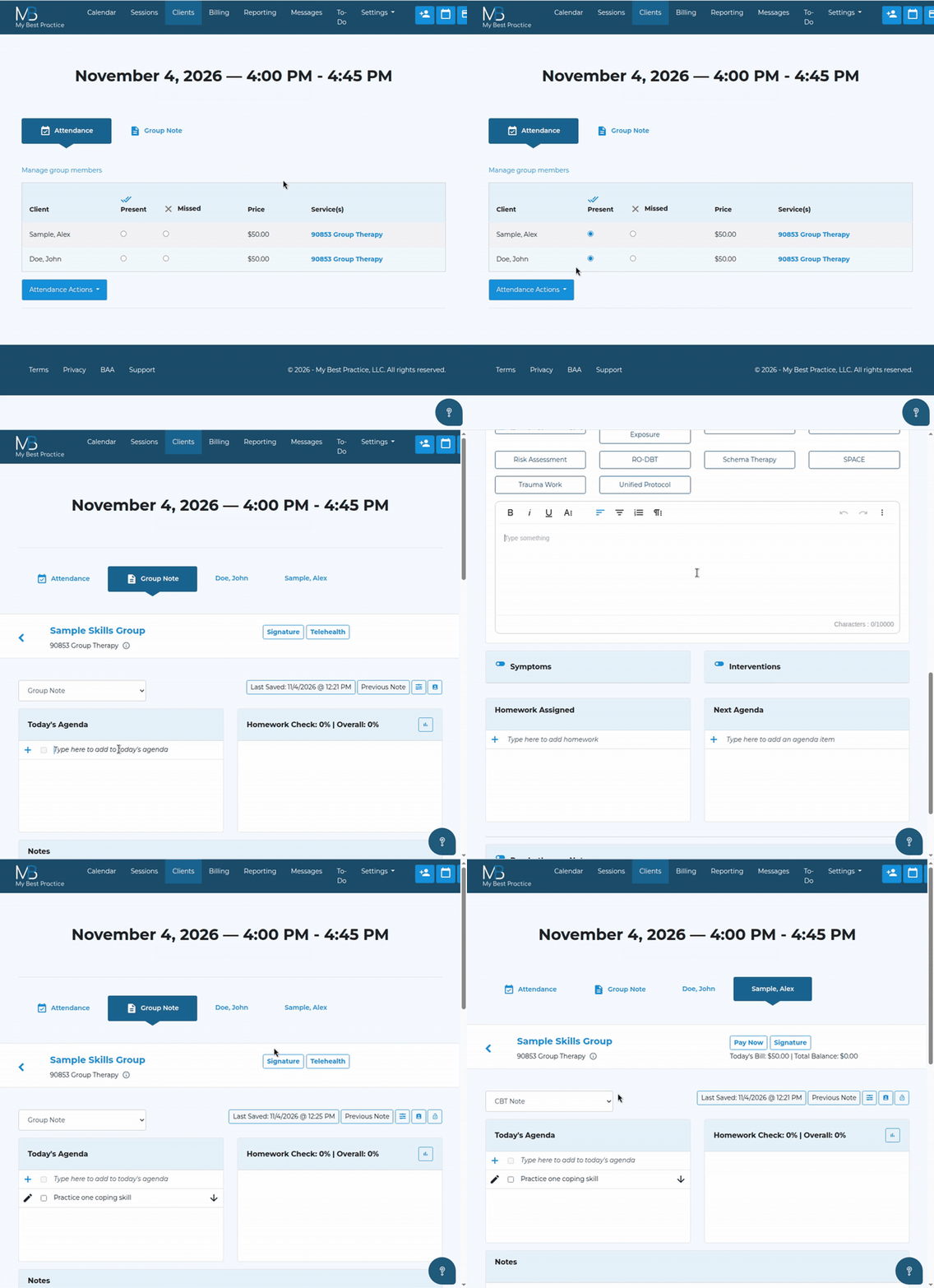
How does one group note reach each client's chart in My Best Practice?
A clinician who leads a group session, as Dr. Edwards' team does three days a week, documents that session in each client's record. After a group, family, or couples session, a clinician in My Best Practice can write one note that goes into each client's individual chart. Novitas, a Medicare contractor, expects each client's record to show the type of service, what the session covered, the therapeutic techniques used, and who provided the service. Our post on how to write group therapy notes for every client in the group also covers whether other group members' names can appear in a client's chart.
What's new in My Best Practice
Can a practice use its own note templates for group sessions?
Yes. Custom session notes for groups are now open to every practice on My Best Practice. A practice can set a default note type for each group, pick a different note type for a single session, and set up AI Progress Notes for the group. A change to a group's default note type applies to future sessions that use that default, and notes already written keep their original format.
More improvements this month
- A practice can review anonymous survey responses from one place: To-Do List, then Surveys to Review, then Anonymous. The responses can be filtered and reviewed one at a time or in bulk. Client names are hidden in this review, the responses remain linked internally, and any identifying details a client types into an answer still show.
- A practice can create more than one client inquiry form for different services and share a public link to each form. The practice's main inquiry link opens whichever form the practice sets as its default.
- Whoever runs an eligibility check can choose a provider, supervisor, or organization NPI for it. Checks can be run from Upcoming Appointments, and saved results are kept in the inquiry history.
- A practice can lock a completed assessment so it can't be edited further. An assigned supervisor can still sign locked assessments, treatment plans, intakes, and case conceptualizations.
- Teams that use Claim.MD can see a client's applicable insurance plans, a warning when a plan is missing, and prefilled copays when available, as soon as they open an appointment. For billed appointments from today or the previous 30 days, the appointment can also show the plan tied to the claim.
- A user can void an eligible PaySimple payment before it settles with the new Void option. Whether Void appears depends on the payment method, the timing, and the user's permissions.
- A practice can set service facility and billing provider details for Boxes 32 and 33 of the CMS-1500 claim form. Provider overrides come first, then facility settings, then payer settings.
- A clinician can type their name and credentials, choose a script style, preview the signature, and save it as their professional signature. A clinician can also draw or upload a signature.
See all of My Best Practice's feature updates.
Start a 14-day free trial of My Best Practice and write one note for your next group session.
Disclaimer: This post is for general information only. It does not provide legal, ethical, or clinical guidance, and it is not a substitute for advice from an attorney, your licensing board, your professional association, or a qualified clinical supervisor or consultant. The study described here took place in one practice, and its findings may not apply to your practice. Before making decisions about your staff, your compliance obligations, or client care, consult the appropriate professionals.
References
- Mistur, E. J., Szkutak, A., Wheaton, M. G., & Edwards, A. R. (2026). Intensive group-based ERP for OCD and anxiety disorders: A naturalistic study in an independent community practice. Cognitive Therapy and Research. https://doi.org/10.1007/s10608-026-10793-4
- My Best Practice. (2026). Inside an intensive treatment program for anxiety and OCD | My Best Practice User Highlight [Video]. YouTube. https://www.youtube.com/watch?v=2EvoBQxjw1A
- My Best Practice. (n.d.). Frequently asked questions. https://www.mbpractice.com/faqs-frequently-asked-questions/
- My Best Practice. (n.d.). How to write group therapy notes for every client in the group. https://www.mbpractice.com/blog/how-to-write-group-therapy-notes-for-every-client/
- New York Anxiety Treatment. (n.d.). 6-week Exposure Intensive Outpatient Program (IOP). https://www.nyanxietytreatment.com/intensive-outpatient-program
- New York Anxiety Treatment. (n.d.). Staff. https://www.nyanxietytreatment.com/staff
- Novitas Solutions. (n.d.). Psychiatric codes (LCD L35101). Centers for Medicare & Medicaid Services, Medicare Coverage Database. https://www.cms.gov/medicare-coverage-database/view/lcd.aspx?lcdid=35101