
In 2005, two researchers published what trained coders had found in the homework discussions of a cognitive therapy trial for depression reported in 1992. The coders rated the discussions in which those therapists assigned homework to 24 clients and reviewed it with them.
Better treatment outcomes were associated with the therapist setting concrete goals for the task and discussing the barriers to completing it, with written reminders of the homework, and with the client taking part in the discussion. The coders rated all of those within the homework discussion itself, both what the therapist and the client did and whether the task was written down.
How do I get clients to do their therapy homework?
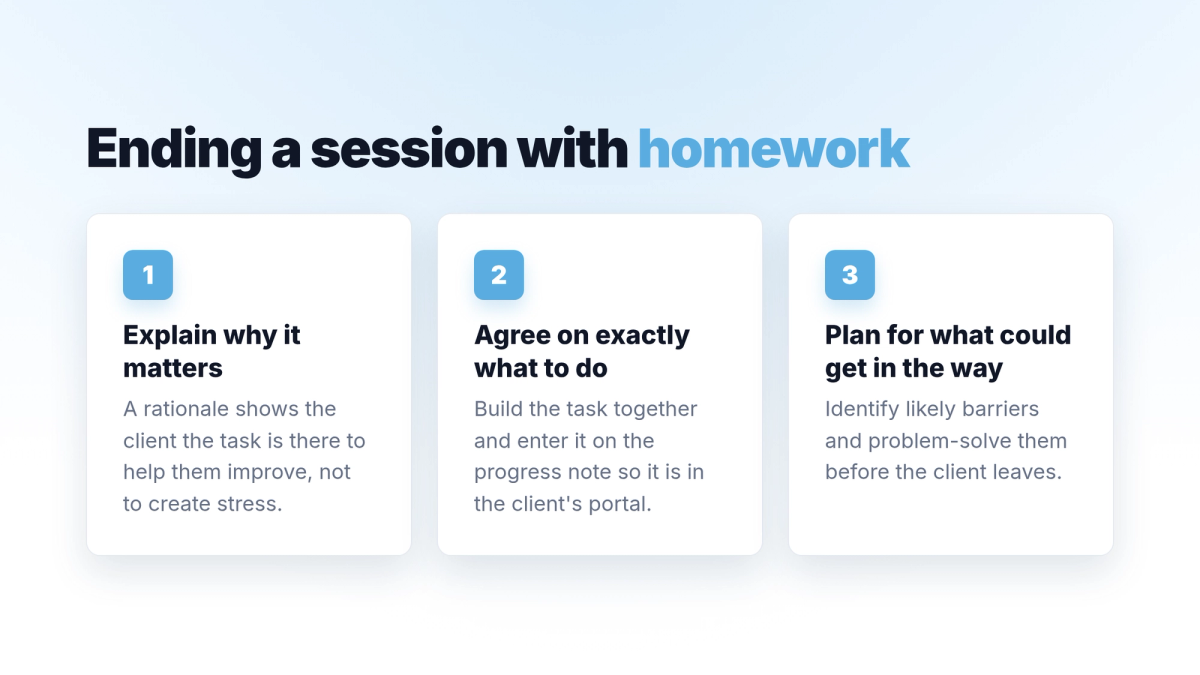
Give the client a reason for the task, write the task down so the client leaves with it, and spend part of the session on what might stop the client from doing it. Providing a rationale for the homework connects them to the reality that the homework is being assigned to help them improve, not to create stress. In addition, preemptively addressing potential barriers is helpful for homework and also gives them practice for skills that help them with their therapeutic goals. In the two studies that coded what therapists did while assigning homework, how the therapist assigned the task predicted whether the client did the work; in the adolescent study, it did so only for the teens least likely to do it, but they may be the ones in the most need. Discussing obstacles mattered for those same teens and could not be tested in the adult study.
A 2013 study of 50 depressed adolescents, aged 14 to 18 and referred for a depressive disorder, coded what their therapists did about homework in the first two sessions and how much homework the teens did in sessions two and three. In the first session, a stronger rationale and more time spent assigning the homework predicted more adherence at the second session, but only for the teens who had been resistant at the start; for the less resistant teens, the association was not observed. In the second session, the rationale, asking for the teen's reactions, and troubleshooting obstacles predicted adherence at the third, again only for the teens who had done less of the first assignment. Across the whole group, none of these behaviors had a main effect on adherence; the study had 33 to 41 teens in each analysis, made no correction for multiple tests, and the authors call replication essential.
A 2018 study of 66 depressed adults in the early sessions of cognitive therapy coded three kinds of therapist behavior: reviewing the last homework, assigning the next one, and helping the client past obstacles, though the obstacle ratings proved too unreliable to analyze. The behaviors involved in assigning homework predicted the client's engagement with both the cognitive therapy homework and homework in general, and in this study the behaviors involved in reviewing homework predicted neither.
A 2004 survey of 77 cognitive-behavioral therapists asked each of them to recall two clients and describe the tasks assigned, how each was assigned, and the problems that arose while assigning and completing them. Homework compliance was associated with the client's motivation for therapy and with better outcomes later in treatment, and also with the therapist providing a written note or a homework sheet on the task. In the regression analyses, client variables were the most important predictors of compliance. A client's motivation for therapy is not something you can schedule, and it can be challenging to get staff to assign homework this way. In fact, it is similar to getting clients to do homework. But motivational techniques from our clinical training can be leveraged in both cases. A supervisor can coach clinicians on how to collaboratively come up with homework assignments. Again, I have found it clinically useful to identify likely challenges to completing a task and problem-solve them in advance; in my experience, this raises compliance and builds the client's problem-solving skills and self-efficacy.
Does homework in therapy improve outcomes?
Yes, in the studies that have been pooled, with the caveat that they are correlations and not controlled comparisons. In fact, one of the earliest studies I ever did (presented only at a conference, when I was a graduate student) demonstrated the importance of homework.
A meta-analysis of 23 studies and 2,183 clients found that the more homework a client did, the better that client's outcome, an effect the authors label small to medium (r = .26) and one that held across diagnoses. None of those studies assigned homework to some clients and withheld it from others, so they cannot show that the homework caused the improvement. The study I find more useful clinically followed 53 depressed adults through their first five sessions of cognitive therapy, with observers rating homework engagement, even though causation is still questionable. A client's symptoms improved more in the weeks when that client engaged with the homework more than usual. The comparison is within the client, week to week, which is the comparison a therapist makes in session. In secondary analyses, the effort the client put in, and finishing the cognitive homework in particular, were the strongest predictors.
The authors closed on the question that matters for a group practice: what does the therapist do that gets a client to engage? Hopefully some of what I suggested is worth experimenting with, i.e., collaboratively develop the assignments, explain the rationale, preemptively identify potential barriers and problem-solve them, and address motivation.
How to assign therapy homework at the end of a CBT session
In my own practice, the last minutes of a CBT session go to the task: why it matters, what exactly the client will do, and what could get in its way. Since I enter it on the progress note in My Best Practice, the assignment is in their portal. That really reduced the “I forgot what it was” moments. At the next session, the therapist can go over the chart of what the client completed, which in my experience is a way to recognize effort and reinforce the client's sense of self-efficacy. Clients frequently appear to feel really good about completing assignments in between sessions. We want it to be about practice and progress, not pleasing the therapist. And that is worth assessing as needed.
I described one such conversation in my guide to measurement-based care in an EHR, where a client's completion chart dipped at the same time as their mood and gave us the focus of the session.
How a group practice tracks therapy homework in the record
I co-founded an EHR, so read this section knowing that.
In My Best Practice, a clinician can write custom progress notes or use templates for all kinds of therapies, e.g., CBT, DBT, ACT and REBT. They can include agenda setting, a cue for checking homework from the previous session, and a metrics tab to make progress monitoring seamless. A DBT practice can even open a Diary Card from the My Best Practice Library that the client has completed. A clinician can carry a repeated assignment forward to the next week with one click instead of retyping it, which leaves more of the session for the rationale and the obstacles. In the next note, the clinician can read what was assigned last session and whether the client has already marked it complete in the client portal, which is the prompt to ask about it.
A clinician can read the client's completion rate charted over time. A supervisor who reviews and signs a supervisee's notes can read the same record in each note: what was assigned and whether the client marked it complete. A clinician can also schedule the PHQ-9 or GAD-7 or any of the more than 100 other routine outcome measures included, with reminders, on any cadence, and see the scores, charted automatically, in the Metrics tab, as part of routine outcome monitoring. This takes so little time with My Best Practice, and there is so much research indicating clients improve faster when we do it, that this is a best practice. We want to make best practices easy.
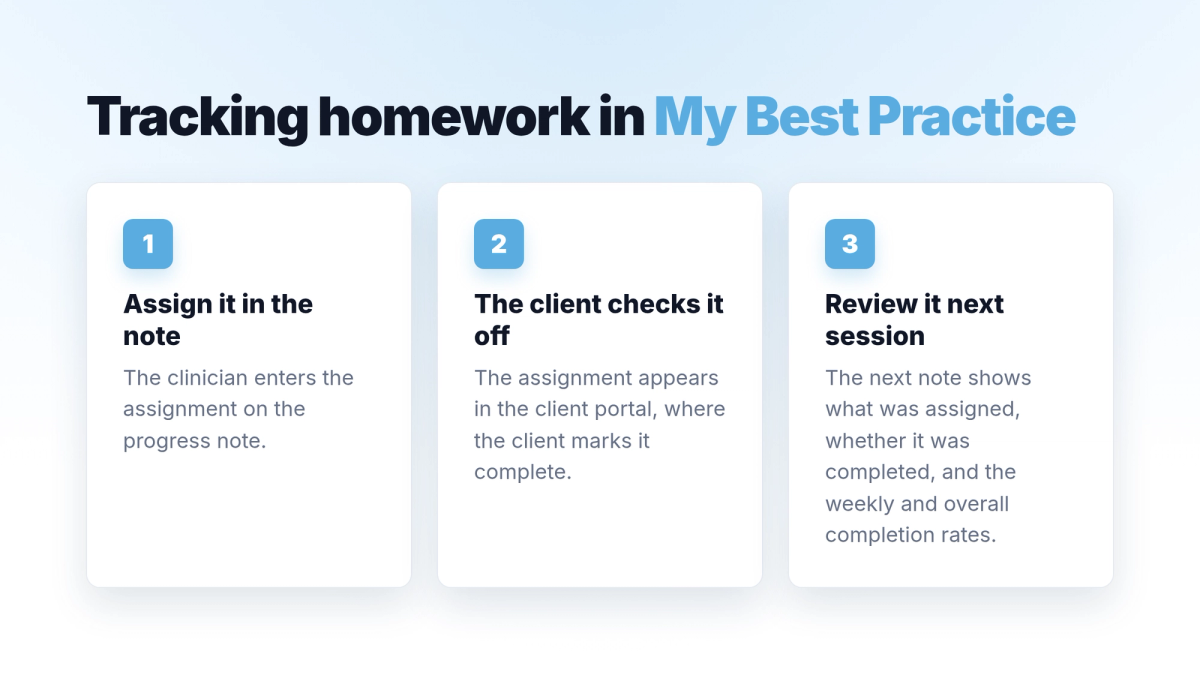
A practice of ten clinicians pays $210 a month for the core EHR, which includes the clinical notes and treatment plans, the client portal and messaging, and the intake forms and custom surveys, as listed on the pricing page. Each of those ten clinicians then ends each CBT session the same way and opens next week's note, already knowing what was assigned and whether the client checked it off.
Start a 14-day free trial and assign your next homework task in it.
Disclaimer: This post is for general information only. It does not provide legal, ethical, or clinical guidance, and it is not a substitute for advice from an attorney, your licensing board, your professional association, or a qualified clinical supervisor or consultant. The studies described here were done in specific settings, and their findings may not apply to your practice. Before making decisions about your staff, your compliance obligations, or client care, consult the appropriate professionals.
About the author
Dr. J. Ryan Fuller is Chief Clinical Officer at My Best Practice. A licensed clinical psychologist, Dr. Fuller specializes in Cognitive Behavioral Therapy (CBT), practice management innovation for group behavioral health practices, and executive coaching. He was the Director of Research at the Albert Ellis Institute and the Director of Behavior for the Obesity Research Center Weight Loss Program in the Columbia Department of Medicine. He has published peer-reviewed research on anger treatment outcomes, irrational beliefs, interpersonal relationships and happiness, and loneliness and obesity. He also founded New York Behavioral Health, a private-pay group practice. Dr. Fuller has been featured on Good Morning America, ABC World News with Diane Sawyer, Katie Couric, and in The New York Times and serves as an expert consultant for group practice technology and clinical implementation. His clinical and business expertise spans behavioral health technology, practice operations, and the intersection of evidence-based clinical work and sustainable business models. He regularly consults with growing group practices on scaling, clinical leadership, and financial modeling.
References
- Conklin, L. R., & Strunk, D. R. (2015). A session-to-session examination of homework engagement in cognitive therapy for depression: Do patients experience immediate benefits? Behaviour Research and Therapy, 72, 56-62. https://doi.org/10.1016/j.brat.2015.06.011
- Conklin, L. R., Strunk, D. R., & Cooper, A. A. (2018). Therapist behaviors as predictors of immediate homework engagement in cognitive therapy for depression. Cognitive Therapy and Research, 42(1), 16-23. https://doi.org/10.1007/s10608-017-9873-6
- Detweiler-Bedell, J. B., & Whisman, M. A. (2005). A lesson in assigning homework: Therapist, client, and task characteristics in cognitive therapy for depression. Professional Psychology: Research and Practice, 36(2), 219-223. https://doi.org/10.1037/0735-7028.36.2.219
- Fuller, J. R. (2026, September 29). Measurement-based care in mental health: An implementation guide for your EHR. My Best Practice. https://www.mbpractice.com/blog/measurement-based-care-implementation-guide-ehr/
- Helbig, S., & Fehm, L. (2004). Problems with homework in CBT: Rare exception or rather frequent? Behavioural and Cognitive Psychotherapy, 32(3), 291-301. https://doi.org/10.1017/S1352465804001365
- Hovmand, O. R., Falkenström, F., Reinholt, N., Bryde, A., Eskildsen, A., Arendt, M., Poulsen, S., Hvenegaard, M., Arnfred, S. M., & Bach, B. S. (2025). What is the effect of homework engagement in group cognitive behavioral therapy for anxiety disorders and depression? BMC Psychology, 13(1), 1002. https://doi.org/10.1186/s40359-025-03167-0
- Jungbluth, N. J., & Shirk, S. R. (2013). Promoting homework adherence in cognitive-behavioral therapy for adolescent depression. Journal of Clinical Child & Adolescent Psychology, 42(4), 545-553. https://doi.org/10.1080/15374416.2012.743105
- Kazantzis, N., Whittington, C., Zelencich, L., Kyrios, M., Norton, P. J., & Hofmann, S. G. (2016). Quantity and quality of homework compliance: A meta-analysis of relations with outcome in cognitive behavior therapy. Behavior Therapy, 47(5), 755-772. https://doi.org/10.1016/j.beth.2016.05.002
- Mausbach, B. T., Moore, R., Roesch, S., Cardenas, V., & Patterson, T. L. (2010). The relationship between homework compliance and therapy outcomes: An updated meta-analysis. Cognitive Therapy and Research, 34(5), 429-438. https://doi.org/10.1007/s10608-010-9297-z