
Clinicians opened more of their clients' questionnaire scores when their supervisors were trained and coached for a year (Williams et al., 2026a). Youth clinics that got only the measurement software and the training made little progress. The coaching was the missing ingredient. An owner who has bought the software and trained the clinicians, and still sees scores go unopened, can look next at what the supervisors do with those scores. With My Best Practice, an electronic health record (EHR), a clinician and a supervisor can each select the Metrics tab and see a client's charted scores.
What does the research say about measurement-based care in a group practice?
Software and training alone did little to get clinicians to open clients' results, and training and coaching their supervisors did more, in a randomized trial in clinics serving youth (Williams et al., 2026a). In measurement-based care, a clinician evaluates a client's symptoms with a measure before or during a session and uses the result to inform treatment (Lewis et al., 2019). To me, measurement-based care is where the science supports the clinical care, and better clinical care also grows the business, which improves access to quality care. This is the virtuous circle practice owners and clinicians strive for.
That trial cannot say whether the same holds with adult clients, because it studied youths. Showing clinicians their clients' scores helped symptoms a little and lowered dropout a little in an earlier meta-analysis, which we covered in how to run routine outcome monitoring in a group practice (de Jong et al., 2021). It found no significant effect on deterioration or on the number of sessions. The authors of an interview study with emerging adults concluded that, without the clinician's follow-through, digital measurement-based care risks becoming an administrative task (Henry et al., 2026). There have been studies that support progress monitoring, i.e., regularly reviewing routine outcome measures (ROMs) (Carlier et al., 2012; Goodman et al., 2013), and training can increase clinicians' use of it (Persons et al., 2016).
What happened when supervisors were trained and coached to lead measurement-based care
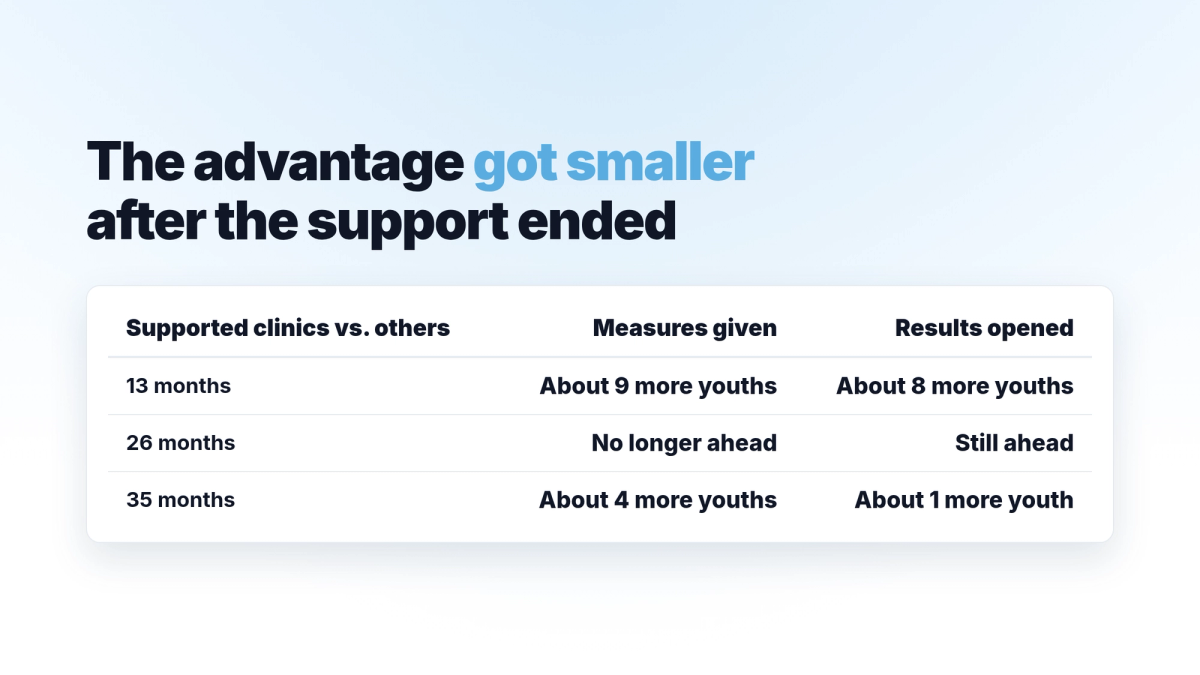
At 13 months, a clinic whose supervisors had the leadership support gave a measure to about 9 more youths a month than a clinic with training and technical assistance alone (mean difference 9.03, 95% confidence interval [CI] 1.64 to 16.41) (Williams et al., 2026a). Its clinicians opened results for about 8 more (8.31, 95% CI 3.07 to 13.56). Opening the results is the step where, the authors say, measurement-based care commonly breaks down, even in well-funded trials. Their reading is that training and aligning leaders did more than get measures completed, and that it changed what clinicians did.
The trial ran in 21 outpatient clinics in Idaho, Oregon, and Nevada, for-profit and not-for-profit, that deliver psychotherapy to youths ages 4 to 17. The 20 clinics analyzed averaged 8.4 and 10.1 full-time-equivalent clinicians in the two groups, which is the size of a group practice. Every clinic got the measurement software at no cost, a one-day training, two booster trainings, and technical assistance. In 11 clinics, the supervisors also got a year of quarterly training, weekly coaching calls, and quarterly strategy meetings with executives. The authors call them first-level leaders, the people who are both clinical supervisor and manager to the clinicians.
These are counts of youths a month, not percentages, so the trial can't tell us what share of each clinic's caseload that represents. The supported clinics were also larger (433 youths served in the prior year versus 330), but the authors statistically adjusted for clinic size.
The advantage got smaller over time. The support lasted a year. At 26 months, the supported clinics were still ahead on results opened but no longer on measures given. At 35 months, they were ahead on both, by about 4 youths given a measure (3.82, 95% CI 1.28 to 6.36) and about 1 whose results were opened (1.41, 95% CI 0.22 to 2.60), differences the authors call relatively small (Williams et al., 2026a). In other words, the leadership support made a real difference, and much of it faded once the support ended.
In the clinics with training and technical assistance alone, measures were given to somewhat more youths, but clinicians made minimal progress, in the authors' words, on opening the results. A result counted as opened when a clinician's access to it was logged, and the trial could not see whether clinicians used the results to guide treatment or shared them with youths and caregivers. This was a secondary analysis, and the authors left one clinic out as an extreme outlier. With 20 clinics, the authors ask for some caution with the statistics and for replication.
Use fell sharply in the supported clinics after the support ended and then leveled off. The authors suggest that removing the support may have removed what was driving the change, though they say earlier research undermines that reading. They also suggest a lack of fit with policy and reimbursement.
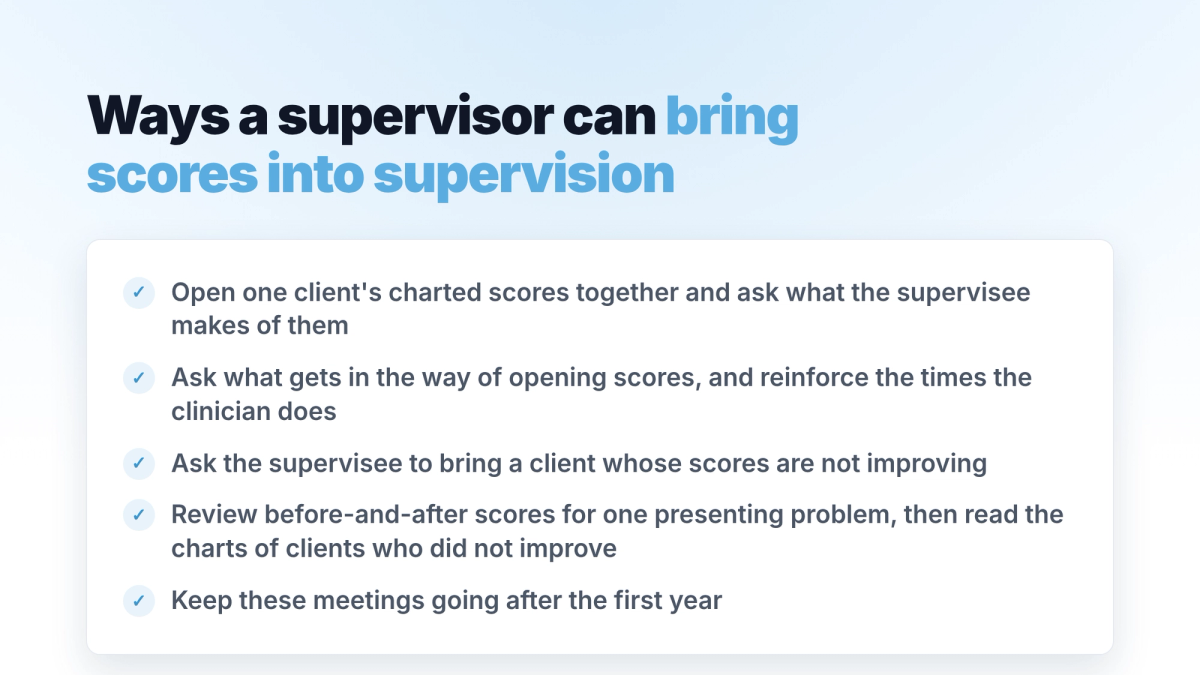
Many leaders in mental health settings, the authors note, are clinicians promoted for clinical competence who are rarely trained to lead a change in practice (Williams et al., 2026a). That's a skill most of us already use with clients, though. When a client doesn't follow through on homework, I am direct and ask what they think gets in the way. I also use shaping, i.e., I reinforce what the client is already doing so there's more of it, while I coach to raise the quality. A supervisor could try the same approach with a clinician who isn't opening scores. Ask what gets in the way, then notice and reinforce the times the clinician does open them and bring them into the session, rather than only flagging the times they don't.
An earlier review gives the clinical reason for watching scores as quickly detecting a client whose health would otherwise deteriorate (Lewis et al., 2019). The later meta-analysis, though, found no significant effect of feedback on the rate of deteriorated cases (odds ratio 1.16, 95% CI 0.99 to 1.35) (de Jong et al., 2021). A couple of things may be worth experimenting with in a group practice, i.e., a supervisor opening one client's charted scores with the supervisee in each supervision meeting and asking what the supervisee makes of them, and keeping those meetings going after the first year. None of these studies tested either one, but the earlier review did suggest that a supervisor ask clinicians for clients' scores when they discuss cases.
What the studies of client scores in clinical supervision found
Supervisors and trainees rarely discussed client scores, and the trainee often started the discussion, in one study in a scoping review of 17 studies (Teti et al., 2026). Whether scores came up was influenced by the supervisor's familiarity with and interest in the measures. In another study, most supervisors preferred to rely on their clinical judgment when supervising and did not bring in clients' scores.
Supervisors who were trained used the scores more consistently in supervision afterward, in two studies with 52 and 42 supervisors (Teti et al., 2026). One was a thesis, and the review cites one of them for supervisees confirming the change. Clients did not do measurably better when the supervisor also saw their scores, in two other studies, though in one of them the therapies were shorter on average (no statistically significant difference in clinical outcomes). Most of the therapists studied were trainees, the samples were small, and the review did not formally assess study quality. A supervisor of interns and externs can apply the review more directly than a supervisor of licensed clinicians.
The review cites prior research finding that therapists and supervisors tend to overestimate the chance of treatment success when they rely on clinical judgment alone. That is the reason it could be worth the supervisor being the one who brings up the scores with trainees, e.g., opening one client's scores before the supervisee presents the case, and asking the supervisee to bring a client whose scores are not improving.
What clients said about completing outcome measures
One client said the digital platform the clinic used for measures “works best when the therapist actually looks at it with you” (Henry et al., 2026). Another said they don't really use it unless it comes up in session. They were emerging adults whom researchers interviewed at two outpatient mental health clinics in southern Alberta, Canada, while in care or soon after discharge. One did not know whether to bring the scores up or wait for the clinician to do it. Some felt the results did not reflect their experience.
The authors caution against expecting a client to keep completing a measure once the client no longer finds it meaningful or useful. This isn't a reason to neglect it, though. I believe this is where education comes in. Completing the ROMs provides clinicians with information they need to provide optimal care. We wouldn't expect to see a cardiologist who doesn't see our blood pressure, heart rate, or even EKG results. We want to work collaboratively with the client and in doing so, cultivate an understanding of how providing us with those data enables us to provide them with the most effective treatments. The authors also cite other work suggesting that repeated self-monitoring may add burden or distress for people vulnerable to anxiety or hypervigilance. This is definitely something to be considered, and a cost-benefit analysis can be done. My thinking is typically that the number or length of the scales can be reduced, but doing away with everything may not be optimal that frequently. But it is critical to evaluate each client on a case-by-case basis. The study's sample was modest and came from two similar programs in one urban area, and one author holds equity in the company behind that platform.
A clinician might experiment with opening the chart with the client early in the session and asking what the client makes of it, so the client sees that the answers were read. It may also be worth agreeing with the client on how often the measure is worth answering, so that it does not become an unspoken expectation (Henry et al., 2026). With a client prone to anxiety, a clinician can ask whether filling it in adds distress.
What two studies of Swedish clinics found about tracking client scores
Therapy got shorter at a Swedish adult psychiatric outpatient clinic that used feedback-informed treatment, but its trend did not differ significantly from that of a clinic that did not use it (p = 0.100), in a retrospective comparison of 139 and 74 clients (Nilsson et al., 2026). In feedback-informed treatment, the clinician and the client complete two brief scales at every session. Waiting time held steady at the feedback clinic, and the two clinics' waiting-time trends moved apart (p = 0.028). Clinicians at the feedback clinic had supervision from a supervisor certified in feedback-informed treatment every two or three weeks. The clinics were not randomized, and two of the authors were the psychologists responsible for the implementation. The authors call the changes modest and describe the findings as hypothesis-generating rather than causal evidence. They put the money cost as likely low and the time for training and supervision as significant.
Two outpatient clinics in Stockholm compiled their clients' scores on the PHQ-9, a depression questionnaire, from before and after treatment and showed them to the managers and staff (Lenhard et al., 2026). The clinic managers judged clients' improvement to be below a research benchmark, and a clinical team then reviewed the records of completed depression treatments. What the clinics changed afterward was mainly case conceptualization and diagnostic understanding. After those changes, clients' improvement on the PHQ-9 was no longer inferior to a later research benchmark, the authors report, but the design does not allow causal inference (Hedges' g of 0.87 to 1.01 before the changes and 1.25 to 1.27 afterward, against a benchmark of 1.51). The quality manager and the two clinic managers who identified the shortfall are coauthors. It is important to consider the coauthors' roles. With that said, I do believe that an accurate case conceptualization is often critical for me in determining not only what the big-picture treatment plan is, but even what I do moment to moment in session, e.g., why I select one technique aimed at a particular mechanism of change.
Something a supervisor could try on a small scale is what the Stockholm clinics did. The supervisor and the clinicians look at before-and-after scores for one presenting problem, and then read together the charts of the clients who did not improve, because reading the records is what led to the Stockholm team's changes. In a small practice those few clients may be recognizable, so it is worth keeping that reading to the clinicians involved in their care.
How a practice can do this in My Best Practice
I co-founded My Best Practice, an evidence-based EHR, so read this section knowing that. About a decade ago I held three roles at once and ran a group practice, and none of them had integrated systems. I took a coding course and built a working EHR, and we used it at New York Behavioral Health. But then, once I needed encryption to travel amongst our offices in Manhattan and Long Island, I knew that was beyond my skillset. So I shelved the idea until my co-founder and I met years later. And he was persistent and technically skilled enough to make it happen on a grand scale. At My Best Practice we help clinicians provide optimal care while reducing the time it takes them to do so with intuitive design, a user-friendly workflow, automation of the mechanical, rote steps that don't require clinical judgment, and scientifically supported features.
A clinician can schedule the PHQ-9, GAD-7, PCL-5, or any of the more than 100 routine outcome measures (ROMs) included, with reminders, on any cadence, scored and charted automatically in the Metrics tab. The client can answer before the session, and the clinician can see the score before they meet. The session note can be a custom note from any theoretical perspective, e.g., Cognitive Behavioral Therapy (CBT), Dialectical Behavior Therapy (DBT), Acceptance and Commitment Therapy (ACT), or Rational Emotive Behavior Therapy (REBT), or a universal template or templates available to every provider. A note can include the Metrics tab, agenda setting, and a prompt to check the previous session's homework. When it would help the client to see the trend, the clinician can share the screen or provide a file or screenshot to the client in their portal.
A supervisor can open a supervisee's notes from their To Do List and sign or countersign them. Very large training clinics, large group practices, and research labs with unlicensed clinicians, supervised interns, and externs use those supervision functions. A DBT clinician can open a Diary Card that the client has completed. The card is in the My Best Practice Library. We want to make best practices easy.
You can read more details where we have written before about running routine outcome monitoring, setting up an EHR for measurement-based care, and clinical supervision in a group practice, if you are interested.
Start a 14-day free trial today.
Disclaimer: This post is for general information only. It does not provide legal, ethical, or clinical guidance, and it is not a substitute for advice from an attorney, your licensing board, your professional association, or a qualified clinical supervisor or consultant. The studies described here were done in specific settings, and their findings may not apply to your practice. Before making decisions about your staff, your compliance obligations, or client care, consult the appropriate professionals.
About the author
Dr. J. Ryan Fuller is Chief Clinical Officer at My Best Practice. A licensed clinical psychologist, Dr. Fuller specializes in Cognitive Behavioral Therapy (CBT), practice management innovation for group behavioral health practices, and executive coaching. He was the Director of Research at the Albert Ellis Institute and the Director of Behavior for the Obesity Research Center Weight Loss Program in the Columbia Department of Medicine. He has published peer-reviewed research on anger treatment outcomes, irrational beliefs, interpersonal relationships and happiness, and loneliness and obesity. He also founded New York Behavioral Health, a private-pay group practice. Dr. Fuller has been featured on Good Morning America, ABC World News with Diane Sawyer, and Katie Couric's talk show, and in The New York Times and The Wall Street Journal, and he serves as an expert consultant for group practice technology and clinical implementation. His clinical and business expertise spans behavioral health technology, practice operations, and the intersection of evidence-based clinical work and sustainable business models. He regularly consults with growing group practices on scaling, clinical leadership, and financial modeling.
References
- Carlier, I. V. E., Meuldijk, D., Van Vliet, I. M., Van Fenema, E., Van der Wee, N. J. A., & Zitman, F. G. (2012). Routine outcome monitoring and feedback on physical or mental health status: Evidence and theory. Journal of Evaluation in Clinical Practice, 18(1), 104-110. https://doi.org/10.1111/j.1365-2753.2010.01543.x
- de Jong, K., Conijn, J. M., Gallagher, R. A. V., Reshetnikova, A. S., Heij, M., & Lutz, M. C. (2021). Using progress feedback to improve outcomes and reduce drop-out, treatment duration, and deterioration: A multilevel meta-analysis. Clinical Psychology Review, 85, Article 102002. https://doi.org/10.1016/j.cpr.2021.102002
- Goodman, J. D., McKay, J. R., & DePhilippis, D. (2013). Progress monitoring in mental health and addiction treatment: A means of improving care. Professional Psychology: Research and Practice, 44(4), 231-246. https://doi.org/10.1037/a0032605
- Henry, G., Habina, C., Barker, M., Mair, E., Potestio, M., Mogan, T., Hews-Girard, J., Bright, K., LaMonica, H. M., Hickie, I. B., Iorfino, F., Arnold, P. D., & Dimitropoulos, G. (2026). Emerging adults' experiences of digital measurement-based care in routine mental health care: Qualitative study and conceptual synthesis. JMIR Formative Research, 10, Article e96322. https://doi.org/10.2196/96322
- Lenhard, F., Amnéus, L. W., Viklund, I., Andersson, E., & Öst, L.-G. (2026). Enhancing clinical depression treatment outcomes: A comprehensive approach using measurement-based care, research benchmarks, and systematic quality improvements. Administration and Policy in Mental Health and Mental Health Services Research, 53(4), 329-337. https://doi.org/10.1007/s10488-026-01499-6
- Lewis, C. C., Boyd, M., Puspitasari, A., Navarro, E., Howard, J., Kassab, H., Hoffman, M., Scott, K., Lyon, A., Douglas, S., Simon, G., & Kroenke, K. (2019). Implementing measurement-based care in behavioral health: A review. JAMA Psychiatry, 76(3), 324-335. https://doi.org/10.1001/jamapsychiatry.2018.3329
- Machleid, F., Michnevich, T., Huang, L., Schröder-Frerkes, L., Wiegmann, C., Muffel, T., & Kaminski, J. (2026). Remote measurement-based care interventions for mental health: Systematic review and meta-analysis. JMIR Mental Health, 13, Article e63088. https://doi.org/10.2196/63088
- Nilsson, M., Rydberg, M., Clausen-Ekefjärd, J., & Westling, S. (2026). Improving access to psychiatric outpatient care through feedback-informed treatment: A study on waiting times and therapy duration in Sweden. BMJ Open Quality, 15(3), Article e004233. https://doi.org/10.1136/bmjoq-2026-004233
- Persons, J. B., Koerner, K., Eidelman, P., Thomas, C., & Liu, H. (2016). Increasing psychotherapists' adoption and implementation of the evidence-based practice of progress monitoring. Behaviour Research and Therapy, 76, 24-31. https://doi.org/10.1016/j.brat.2015.11.004
- Teti, A., Lo Coco, G., Gelo, O. C. G., Lagetto, G., Tasca, G., & Gullo, S. (2026). The use of routine outcome monitoring in clinical supervision: A scoping review of empirical evidence. Clinical Psychology & Psychotherapy, 33(5), Article e70314. https://doi.org/10.1002/cpp.70314
- Williams, N. J., Aarons, G. A., Ehrhart, M. G., Vega, N., & Marcus, S. C. (2026a). Effects of a leadership-focused implementation strategy on uptake of digital measurement-based care in mental health clinics: A cluster randomized trial. Translational Behavioral Medicine, 16(1), Article ibag007. https://doi.org/10.1093/tbm/ibag007
- Williams, N. J., Choy-Brown, M., Vega, N., Aarons, G. A., Ehrhart, M. G., & Marcus, S. C. (2026b). Testing normalization process theory in a randomized trial of mental health clinics implementing digital measurement-based care. Implementation Science, 21(1), Article 16. https://doi.org/10.1186/s13012-026-01485-4