
An owner who opens a second office can keep one schedule and one client list, and can still see what each office bills and collects. On My Best Practice, a scheduler can book each appointment into a room at either office. A client booked at the second office gets a reminder with the text the owner wrote for that office. The owner can then filter the Billed vs. Collected report to read what each office billed and collected to have a precise understanding of the financials.
How do you run multiple locations on one group practice EHR?
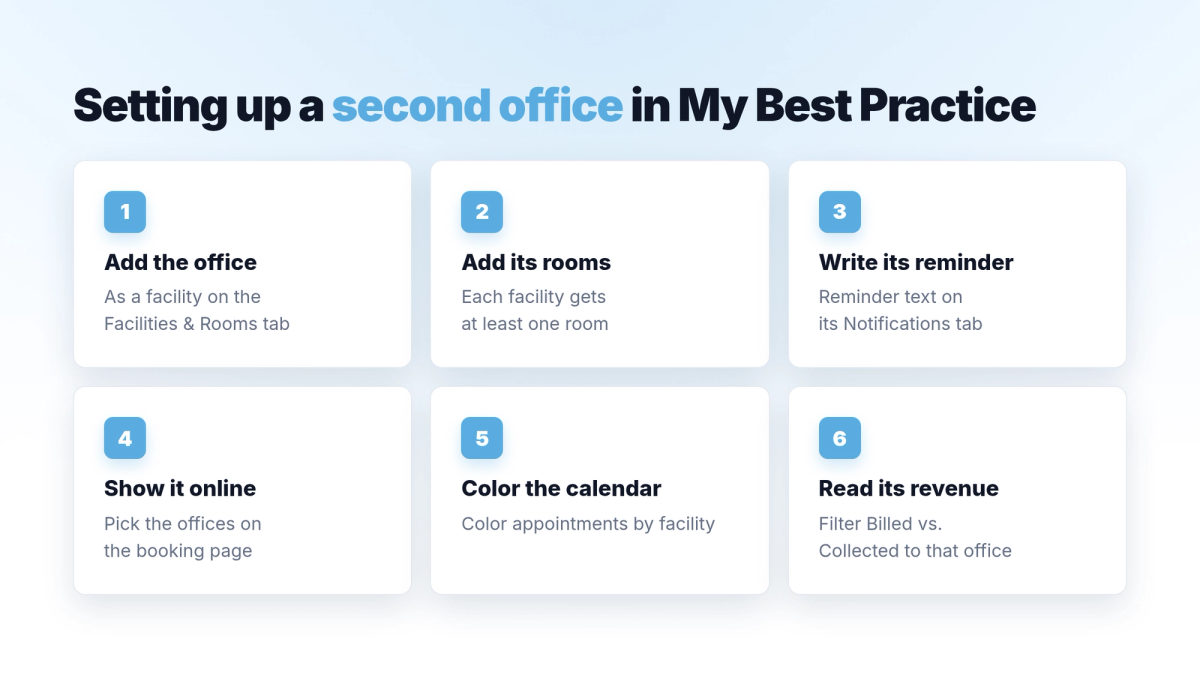
In My Best Practice, each office is called a facility. An administrator can add each office to the practice's account as a facility on the Facilities & Rooms tab in Account Settings. Each facility gets at least one room. An owner can then manage the offices and their clinicians from one electronic health record (EHR) account.
For each facility, an administrator can enter the office's name and contact details, an Invoice Name that heads that facility's superbills, and a description of each room so that administrators can tell the rooms apart.
Reminder text for each office
A client booked at the second office needs a reminder that says so. An owner can enter each office's reminder text on that facility's Notifications tab in Facilities & Rooms, and the text is included in text and email reminders based on the facility or room assigned to the appointment.
Reminders reduced missed appointments in all but one of the 31 randomized trials in a systematic review that covered all health care settings (McLean et al., 2016). The same review found weak but consistent evidence, from five studies, that a reminder with additional information reduces missed appointments more than a simple one that gives the date, time, and location. An office's reminder text is a place for that information, for example which entrance to use at the second office.
Persuasive wording did not help in one trial. At the Veterans Affairs (VA) Portland Health Care System, which included two medical centers and six satellite clinics, scheduling staff mailed a reminder letter that named the clinic and gave its location, the provider, the date, and the time of the appointment (Teo et al., 2023). Researchers added nudge messages to some of those letters, brief lines about social norms, what to do, or the consequences of missing an appointment, and the missed appointment rate did not change in primary care or mental health clinics. The authors suggest that a missed appointment rate of 20% in mental health clinics is perhaps as good as a clinic can practically achieve without addressing the larger social issues behind missed appointments.
So that a client who books online picks the right office, an administrator can choose which of the practice's facilities appear on the online booking page and change the name shown for each one.
An owner who offers telehealth can add it as a facility of its own, named for example Telehealth Session, and write reminder text for it. In a retrospective study of 55 Federally Qualified Health Center clinics in Texas, telemedicine appointments were associated with 13% lower odds of being missed, but the design establishes an association and not a cause (Adepoju et al., 2022).
Both offices on one calendar
A scheduler who books for two offices needs to see both at once. On one calendar, a scheduler can see several clinicians and both offices. To tell the offices apart, the scheduler can color the calendar by facility in the calendar settings, and each appointment then takes the color an administrator selected for its office.
An administrator can set each professional's availability for each day in Staff & Users. A scheduler who turns on availability in the calendar settings can book inside those hours, or turn it off to schedule outside them. A clinician at either office can switch between single-provider and multi-provider calendar views and turn on two-way sync with Google Calendar.
Location codes and claim form details for each office
The room a scheduler picks for an appointment determines the Location Code on the superbill, for example 2 for a telehealth appointment and 11 for an in-person one. An administrator can select each facility's Location Code from a dropdown, and selecting Telehealth for a telehealth facility also puts the location code on e-claims for appointments with that facility.
When two offices need different service facility or billing provider information on their claims, a biller can open a facility, go to its Insurance tab, and fill in the override fields for Box 32 (Service Facility) and Box 33 (Billing Provider) on CMS-1500 claims (CMS is the Centers for Medicare & Medicaid Services). If a biller sets an override for a facility, it takes precedence over the professional's default information, and a payer-specific override takes precedence over both.
Billed and collected revenue for one office
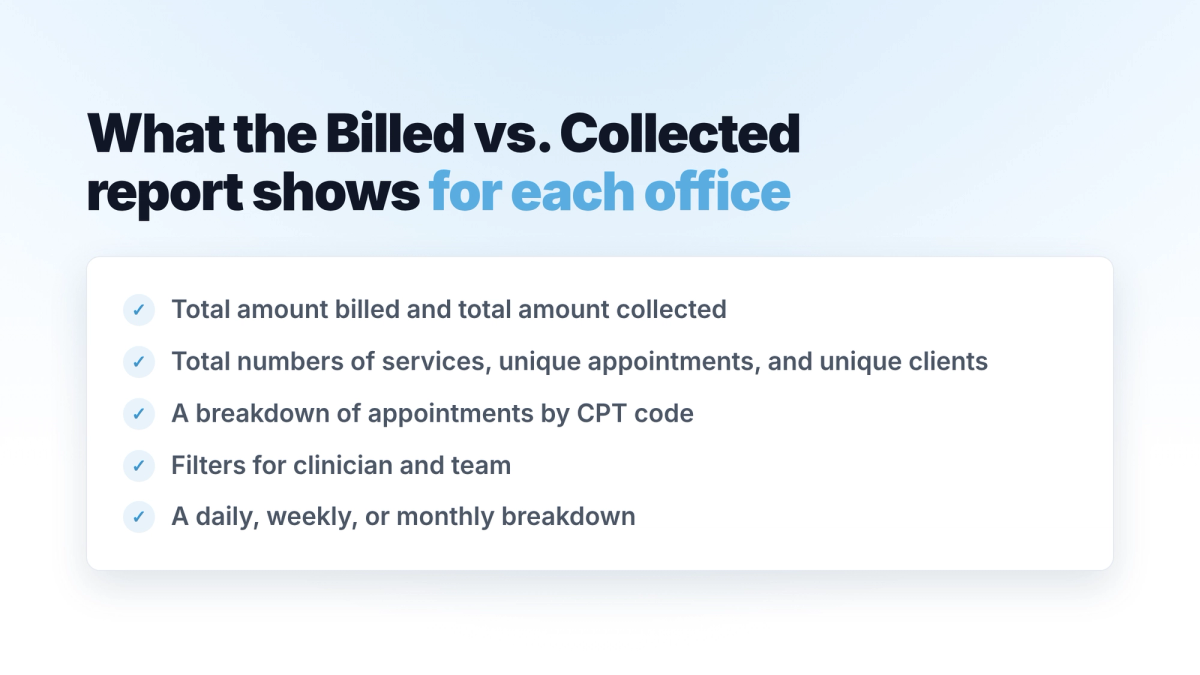
An owner can run the Billed vs. Collected report on the Reporting tab for a chosen date range and filter it to one facility or several. For the selected facilities, the owner can then read the total amount billed, the total amount collected, the total numbers of services, unique appointments, and unique clients, and a breakdown of appointments by Current Procedural Terminology (CPT) code. The owner can also filter by Clinician and by Team and choose a daily, weekly, or monthly timeframe breakdown.
An owner with two offices has a reason to read each office's totals separately. In a retrospective study of the Michael E. DeBakey VA Medical Center in Houston and 10 other VA hospitals in its region, no-show rates differed significantly among the hospitals and among different clinics in those hospitals (Kheirkhah et al., 2016). The authors measured no-shows at VA hospitals, but not revenue at a group practice.
To pay the clinicians, an owner can use the payroll report to calculate clinician compensation using percentages or fixed amounts tied to billing codes.
Which access level each staff member gets
In Staff & Users, an administrator can assign each staff member one of these user types.
| User type | What a person with that user type can do |
|---|---|
| Standard User | Have full access to the client lists of the additional professionals selected for this user, in addition to their own |
| Basic Administrator | Access all data, with permission to view all account settings and information for all other professionals, including client lists, billing, and payroll |
| Full Administration | Access all data and make changes to account-level settings |
An administrator can also make a non-clinical staff member a basic administrator or a full administrator. A full administrator can turn on a setting called Can View Billing for one person at a time. When a client sees a clinician at each office, a staff member can add the second clinician to the client's chart on the chart's Professionals tab.
My Best Practice signs a Business Associate Agreement (BAA) with every practice.
What a clinician and a supervisor can do at either office
A clinician at either office can write a custom note from any theoretical perspective, e.g., Cognitive Behavioral Therapy (CBT), Dialectical Behavior Therapy (DBT), Acceptance and Commitment Therapy (ACT), or Rational Emotive Behavior Therapy (REBT), or a universal template or templates available to every provider. The clinician can send a client the PHQ-9, GAD-7, PCL-5, or any of the more than 100 routine outcome measures (ROMs) included, with reminders, on any cadence, scored and charted automatically in the Metrics tab. A clinician who opens a note can see the agenda items from the previous appointment and the homework the client was assigned. A DBT practice can open a Diary Card the client has completed from the My Best Practice Library. In the same account, a supervisor can open a supervisee's notes from their To Do List and sign or countersign them. We want to make best practices easy.
What My Best Practice costs a group practice
The first clinician on My Best Practice costs $39 a month, each additional clinician costs $19, and telehealth is optional at $20 a month per clinician. An owner can add a scheduler or a biller for the second office without paying for the account.
Try My Best Practice free for 14 days, no credit card needed.
Disclaimer: This post is for general information only. It does not provide legal, ethical, or clinical guidance, and it is not a substitute for advice from an attorney, your licensing board, your professional association, or a qualified clinical supervisor or consultant. The studies described here were done in Veterans Affairs health systems and a network of Federally Qualified Health Center clinics, with one evidence synthesis that covered all health care settings, and their findings may not apply to your practice. Before making decisions about your staff, your compliance obligations, or client care, consult the appropriate professionals.
References
- Adepoju, O. E., Chae, M., Liaw, W., Angelocci, T., Millard, P., & Matuk-Villazon, O. (2022). Transition to telemedicine and its impact on missed appointments in community-based clinics. Annals of Medicine, 54(1), 98-107. https://doi.org/10.1080/07853890.2021.2019826
- Kheirkhah, P., Feng, Q., Travis, L. M., Tavakoli-Tabasi, S., & Sharafkhaneh, A. (2016). Prevalence, predictors and economic consequences of no-shows. BMC Health Services Research, 16, Article 13. https://doi.org/10.1186/s12913-015-1243-z
- McLean, S. M., Booth, A., Gee, M., Salway, S., Cobb, M., Bhanbhro, S., & Nancarrow, S. A. (2016). Appointment reminder systems are effective but not optimal: Results of a systematic review and evidence synthesis employing realist principles. Patient Preference and Adherence, 10, 479-499. https://doi.org/10.2147/PPA.S93046
- Teo, A. R., Niederhausen, M., Handley, R., Metcalf, E. E., Call, A. A., Jacob, R. L., Zikmund-Fisher, B. J., Dobscha, S. K., & Kaboli, P. J. (2023). Using nudges to reduce missed appointments in primary care and mental health: A pragmatic trial. Journal of General Internal Medicine, 38(Suppl 3), 894-904. https://doi.org/10.1007/s11606-023-08131-5